
No products
Product successfully added to your shopping cart
There are 0 items in your cart. There is 1 item in your cart.
Masterpieces V There are 55 Lots.
-
Startpreis / Startingbid
20 000 €Lot: 21
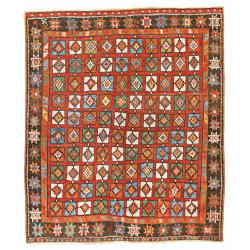
Kütahya Yatak216 x 186 cm (7' 1" x 6' 1")
Turkey, 18th century
Condition: very good, mostly good pile, partially corroded dark brown, minor small repairs
Warp: wool, weft: wool, pile: wool
Heavy, mostly nearly square rugs with a high pile are called "yatak" and were used as sleeping rugs. In Böhmer and Brüggemann's standard work on the rugs of the farmers and nomads of Anatolia, such a rug is published under No. 51; it differs only slightly from our example. The main difference is that it lacks the inner S-shaped border found on our piece, which further frames the field and visually highlights it.
The Prammer Collection contains a fragment of a Kütahya rug with a comparable design, published in "2000 and One Night," Graz 2001, no. 171. However, the interior design of the squares differs from that of our piece. In this example, a cube-shaped motif is additionally placed between the squares. This visually extends the lines and creates a distinctly different overall impression.
A comparable piece was offered on December 5, 2009, at Rippon Boswell as Lot 75 for 38,000.
The star border on a dark background also deserves special attention. At the bottom and top left, additional cubes have been inserted between the stars, apparently in places where there was not enough space for another complete star.
It is particularly fascinating to observe how the weaver initially had to find her way into the pattern at the bottom end. It was not until the second row that she settled on a clear color sequence, creating a diagonal pattern; the individual squares also begin to align regularly one above the other only from this point on. It is precisely these small irregularities that make the rug's creation process immediately apparent and lend it a very special charm.
Estimate: € 30000 - 4000020 000 € -
Startpreis / Startingbid
8 000 €Lot: 22
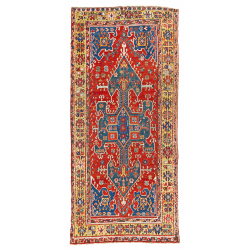
Dazkir345 x 158 cm (11' 4" x 5' 2")
Turkey, first half 19th century
Condition: good, scattered low pile, sides and ends minimally incomplete, some old repairs, signs of use
Warp: wool, weft: wool, pile: wool
Brian Morehouse published his widely cited article "Menderes Valley Carpets" in HALI 121, pp. 100-107, in which he examined the relationships between the carpets of this region and other weaving areas - mostly located further north - as well as their earlier models. Dazkiri, situated at the eastern end of the Menderes Valley, plays a central role in this context.
In addition to the Transylvanian type - of which we are also pleased to offer an example in this auction - Morehouse also discusses the design group to which our carpet belongs; see p. 104, no. 14.
A massive, elongated medallion dominates the field. Its basic form can be traced, through various intermediate stages, back to the medallion of a Star Ushak. If you turn to the corresponding example in our catalog, you will recognize the underlying form in principle. Due to the narrower format, the lateral extensions here are reduced to protruding white double hooks. Four squares appear in the center; if one simplifies the star within them, one ultimately arrives at the pointed cross of our carpet. The design of the corner spandrels also completes this image.
Some interesting comparative examples and formal intermediate stages - which, notably, do not represent a chronological sequence of development - can be found in Michael Franses, "Orient Stars II," HALI Publications 2021, Nos. 18 and 19, as well as Figs. 220 and 221.
In keeping with an independent village or nomadic reinterpretation of older weaving traditions, the weaver also added an unmistakably personal touch: a water jug appears completely unexpectedly in the upper right blue spandrel. A small, almost casually inserted detail that lends a charming, individual touch to the otherwise strictly geometric composition.
Colorful, carefree, and expressive, this carpet stands as an exemplary piece of the art of weaving from the Dazkiri region.
Estimate: € 12000 - 160008 000 € -
Startpreis / Startingbid
20 000 €Lot: 23
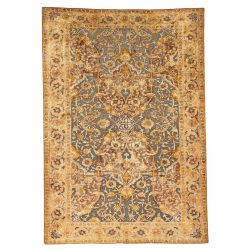
Silk Kum Kapi with metal brocade258 x 179 cm (8' 6" x 5' 10")
Turkey, ca. 1920
Condition: good, scattered low pile, scattered small repairs at the upper end, lower left corner slightly damaged
Warp: silk, weft: silk, pile: silk with metal brocade
This finely woven Kum Kapi carpet belongs to a group of luxurious silk carpets produced in the Armenian workshops of Istanbul's Kum Kapi district during the final decades of the Ottoman Empire. Technically, these works rank among the most sophisticated woven carpets of their era. Among the most famous masters were Hagop Kapoudjian and Zareh Penyamin.
In muted colors, our piece continues the tradition of the so-called "Polonaise" carpets. The Thyssen-Bornemisza Collection includes such a carpet from the second quarter of the 17th century, which displays nearly the same pattern as our carpet.
See Friedrich Spuhler, "Carpets and Textiles. The Thyssen-Bornemisza Collection," 1998, no. 28.
The medallions, arranged in a mirror pattern around the small central rosette, are connected along an axis to other medallions that are also mirrored and cut off at the edges. This exceptionally sophisticated design can be traced back even further to the famous Clam-Gallas carpet from the late 16th century.
Although the border of the Thyssen carpet is similar to that of our piece, it appears more subtle as it is not divided into two colors. In addition to the design, the materials used and the color scheme of these elegant pieces also show clear parallels. The sections flat-woven with metal threads and the precious silk underscore the luxurious character and extraordinary elegance of these exquisite works.
Estimate: € 30000 - 4000020 000 € -
Startpreis / Startingbid
5 000 €Lot: 24
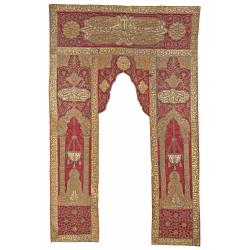
Ottoman Door Hanging300 x 190 cm (9' 10" x 6' 3")
Turkey, 19th century
Condition: good, scattered small areas of wear and holes, minor small repairs, signs of use, backed with fabric
Silk and metal threads on silk
For centuries, gold and silver thread embroidery was a highly specialized craft in the Ottoman Empire. These luxurious textiles were used for everything from shawls and blankets to clothing and even the famous hangings of the Kaaba in Mecca. Large curtains for the portals of mosques were crafted from gold and silk.
Our magnificent piece features inscribed bands as all-around borders, as well as cartouches and medallions. Particularly beautiful are the niches visible on both long sides. They offer a glimpse into a mosque, much as we see on carpets. An elegantly rendered pediment is supported by two columns. The niche is dominated by a massive lamp standing above a delicately rendered vase from which flowers emerge.
The architectural design - featuring a niche within a niche - reflects the influence of European art, which had been increasingly evident in the Ottoman Empire since the 18th century. The delicate tulips beneath the white cartouche, on the other hand, attest to the Ottomans' particular fondness for this motif.
Mosque hangings typically feature ornately designed squares in the lower section. On our piece, a complex star-shaped lattice can be seen there.
In terms of its overall composition, color scheme, and calligraphic design, our piece resembles a door frame - albeit without a mosque depiction - that was auctioned at Christie's for £11,750. That piece was likely slightly reduced in length at the lower ends (Christie's, October 15, 2003, Lot 161).
Estimate: € 8000 - 120005 000 € -
Startpreis / Startingbid
24 000 €Lot: 25
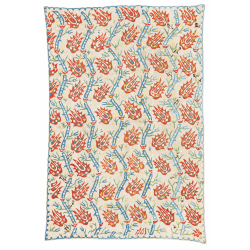
Ottoman Embroidery193 x 130 cm (6' 4" x 4' 3")
Turkey, 17th century
Condition: very good for its age, partially corroded brown, scattered small repairs, signs of use
Silk on cotton
In Turkey, embroidery was more deeply embedded in everyday life than in almost any other country. There were embroidered wallets, hand towels, bath towels, bed sheets for circumcision ceremonies, belts, pillows, tablecloths, gift cloths, turban covers, and even barber's capes - all exquisitely embroidered with silk or metallic threads.
Large white-ground embroideries, which were used as bedspreads or wall hangings, have always been in high demand on the art market. A watercolor in the Austrian National Library, Codex Vindobonensis, No. 8626, fol. 116r, dating from around 1590, illustrates their use beautifully; see Sumru Belger Krody, "Flowers of Silk & Gold," p. 75.
Some of these embroideries feature upward-reaching tendrils adorned with flowers. In our piece, they are wonderfully swaying tulips, with a small sprig of flowers inserted into each bloom. A botanically accurate depiction was obviously not the intention here. Rather, the aim was to heighten the sensory impression and evoke a lush paradise garden.
The large tulips are accompanied by smaller yellow and blue tulips with green stems. Quite similar depictions can be found on two Ottoman embroideries in the Victoria and Albert Museum in London, Inv. No. T.44-1940 and Inv. No. 121-1899. Both pieces are also illustrated in Marianne Ellis and Jennifer Wearden, "Ottoman Embroideries," V&A Publications, 2001, pp. 38-39.
Estimate: € 40000 - 6000024 000 € -
Startpreis / Startingbid
6 000 €Lot: 26
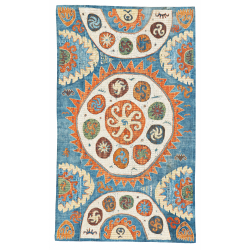
Kaitag Textile96 x 57 cm (3' 2" x 1' 10")
Caucasus, 18th century
Condition: very good, slight abrasions, slight signs of use
Silk on cotton
A surprisingly large number of these embroideries from Dagestan are made on a blue, hand-woven cotton ground. Red or white grounds are less common, while green is extremely rare. Whether this choice of color had a special meaning - after all, the embroideries were intended, among other things, to cover children's cradles - or whether it was due to other circumstances remains unclear.
At the end of life, these textiles took on yet another, entirely different function: they were placed over the face of the deceased. A textile from the cradle to the grave.
Only a very limited number of these expressive embroideries exist. Although their patterns can sometimes be attributed to specific groups, each piece is ultimately highly individual in design. For our specimen, there is no direct comparison to be found in Robert Chenciner's groundbreaking book Kaitag - Textile Art from Daghestan. At best, pieces nos. 141-144, with their interconnected circular medallions and swastika swirls, offer a certain resemblance. There, too, semicircles feature in the composition, but aside from the missing halo and the different secondary motifs, the overall impression differs significantly from our piece.
However, on January 27, 2024, we were fortunate enough to sell a piece on a dark blue background - one that could almost be described as a "sister piece" - for a comparatively reasonable 9,500. Apart from the darker background color, the main difference is that a cross is depicted in the center instead of the "octopod."
This embroidery features lighter colors overall, giving it a somewhat lighter feel, and its design also appears more playful. A direct comparison of the two pieces makes it clear just how freely the embroiderers were able to design their compositions within what appears to be a shared vocabulary of designs.
Estimate: € 10000 - 150006 000 € -
Startpreis / Startingbid
4 000 €Lot: 27
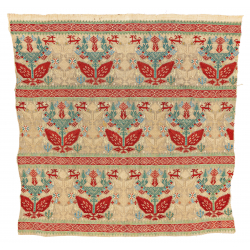
Greek Embroidery Fragment77 x 76 cm (2' 6" x 2' 6")
Greece (Patmos), 17th century
Condition: fragment, slight signs of wear on the sides, overall in good condition
Silk on linen
Ancient Greek embroideries have survived in significantly smaller numbers on the European mainland than in English collections. This may be due, among other things, to the British interest in Greece, which has been particularly pronounced since the time of Lord Byron. English researchers, travelers, and collectors were on the ground from an early stage and began collecting historical embroideries.
One of the best known among them was Alan John Bayard Wace, who served as director of the British School at Athens from 1914 to 1923 and later worked at the Victoria & Albert Museum. In 1935, he published Mrs. F. H. Cook's collection in the two-volume work Mediterranean & Near Eastern Embroideries.
Plate LXVII depicts a bed curtain from Patmos, which features an embroidered band consisting of three panels repeated twice in the lower section and is also dated to the 17th century. A small but striking difference from our piece is that the animals depicted there have two horns rather than antlers.
These fine silk-embroidered textiles are rare and, as a result, highly sought after. Two differently designed and differently colored small flowering trees alternate with one another, and only upon closer inspection does the astonishing variety of animals depicted between them become apparent.
Particularly charming is the medieval-style red border. Within the diamonds appears an animal with a heraldic appearance, which is also found in the calyx of the green flower. Hidden within the spherical shapes below the deer are cross-shaped motifs reminiscent of Crusader crosses.
Two other comparable examples are published in "Greek Embroideries," Benaki Museum, 1980, no. 53, and in Margaret Gentles, "Turkish and Greek Island Embroideries," Art Institute of Chicago, 1964, no. 53.
Estimate: € 6000 - 80004 000 € -
Startpreis / Startingbid
3 000 €Lot: 28
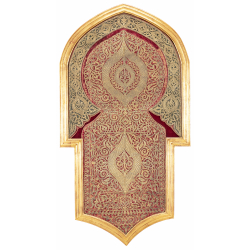
Moroccan Wall Hanging (Haiti)112 x 57 cm (3' 8" x 1' 10")
Morocco, mid 19th century
Condition: very good, slight abrasions, slight signs of use
Metal threads on silk velvet, in a gold-colored wooden frame
Haiti are Moroccan wall hangings that were used on special occasions such as weddings or when receiving dignitaries. They are often made of red and green fabrics worked using the appliqué technique; see, for example, Christie's, June 14, 2017, Lot 343. Several panels were sewn together to form a long wall hanging. Particularly valuable examples were embroidered on velvet with gold and silver threads and were affordable only to the wealthiest families. At weddings, the bride sat on a kind of throne, while behind her, opposite the entrance, such a heavy and magnificent hanging was displayed. An exceptional example of such a ceremonial hanging is housed at the Indianapolis Museum of Art and is prominently featured on the cover of "Fabrics in Celebration from the Collection", 1983; see also HALI 66, p. 90. An image can also be found on Wikimedia Commons.
In the center of this drapery are two niches, in the lower sections of which larger areas of the silk velvet background remain visible. The right-hand niche is closely related to our piece. In particular, the Star of David, subtly incorporated into the composition, links the two embroideries. Typically, pieces of leather or cardboard cut into the desired pattern shape were applied to the velvet and then completely embroidered over with metal threads. In the 19th century, this work was supervised by the leather embroiderers' guild. Around the golden pointed oval, one can particularly appreciate the sophistication with which the embroiderers alternated the lines so that they ran both above and below the leaves. This creates a surprisingly vivid, almost three-dimensional effect. This rare and precious embroidery thus combines precisely the qualities one would hope to find in such a piece. A complete ceremonial hanging more than four meters long, like the example in Indianapolis, is difficult to display in a modern interior. Our piece, however, preserves all the splendor and artisanal sophistication of these monumental hangings in a format that is much easier to display.
Estimate: € 6000 - 80003 000 € -
Startpreis / Startingbid
24 000 €Lot: 29
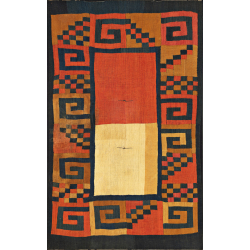
Large Early South American Tunic212 x 133 cm (6' 11" x 4' 4")
South America, 2nd - 6th century A.D.
Condition: very good for its age, scattered small repairs, mounted on a frame
Provenance: Hilmar Kopper collection, Rothenbach
Alpaca or llama wool and cotton
A textile that is incredibly striking from a visual standpoint. As with most pieces in this group, the color scheme of the main field is limited to orange-red and yellow. A distinctive feature of our piece, however, is the contrasting stripe within the yellow area. In the center of the cloak, the threads were left out to create a slit through which the head could be slipped. To secure this opening, an additional blue thread was woven in at both the top and bottom ends. The imposing border is dominated by large G-shaped hooks that alternate rhythmically with cube-shaped motifs. This precious fabric was created at a time when the Romans still ruled Austria. We owe it to the extremely arid desert regions along the west coast of South America that textiles of such extraordinary age have survived at all. But our textile has astonishing features to offer not only graphically but also technically. When we referred to "weft threads" above, this is, strictly speaking, not entirely correct. Normally, the weft is defined as the system of threads running transversely that crosses a continuous warp. However, there is no such continuous warp here. Rather, both the warp and the weft are interrupted and connected to one another by single or double interlacing.
This elaborate technique makes production extremely labor-intensive, but at the same time results in a surprisingly light and airy fabric - ideal for a cloak worn in a hot and dry climate. Hilmar Kopper served, among other roles, as chairman of the supervisory board of Deutsche Bank and became known to the general public for his remark that outstanding invoices from tradespeople totaling around 50 million Deutschmarks were "peanuts." He was undoubtedly more adept at collecting art than he was at dealing with the public. The first part of his collection was auctioned at Van Ham in 2022 for a total of approximately 8.3 million euros. It is easy to understand why a collector of modern and abstract art would be fascinated by such a textile artwork. With its radical reduction of colors, monumental graphic design, and the almost abstract interplay of geometric shapes, this fabric - which is more than a thousand years old - appears astonishingly modern.
Estimate: € 40000 - 6000024 000 € -
Startpreis / Startingbid
5 000 €Lot: 30
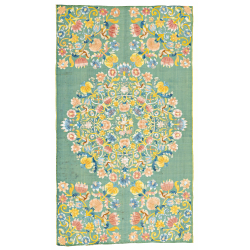
Double-sided Portuguese Embroidery178 x 102 cm (5' 10" x 3' 4")
Portugal, 18th century
Condition: very good, minor damage to the base fabric, slightly stained
Silk on silk
This colorful embroidery from the city of Castelo Branco in western Portugal captivates us with its charm and cheerfulness.
A radiant, blossoming medallion is surrounded by lush bouquets of flowers that converge toward the center. The yellow tendrils within the bouquets are elegantly arranged to suggest flower vases.
Upon closer inspection, we discover a pair of cheerfully chirping birds. The crest of these birds resembles that of a hoopoe, though they have a sort of crop beneath their beaks. This bird also appears in other Portuguese embroideries.
Within the medallion, the yellow tendrils tie the overflowing flowers to the circular frame. At the center, another hoopoe is depicted. On some embroideries of this type, double eagles or even single eagles in a similar pose can be found in the same spot. Our more harmless bird also appears in a heraldic pose, yet seems to be winking at us.
Our piece differs from typical Castelo Branco embroideries in two ways. First, the composition is best viewed horizontally. Far more important, however, is the fact that it appears exceptionally clear and well-organized, leaving large sections of the green silk ground visible. More typical is a white linen ground that is embroidered almost entirely across its surface.
A southern Italian origin cannot therefore be entirely ruled out. Either way, this wonderful double-sided piece, with its excellently preserved colors, is a gem for any collection.
Estimate: € 8000 - 120005 000 € -
Startpreis / Startingbid
8 000 €Lot: 31
Sarmakand Nim Suzani157 x 118 cm (5' 2" x 3' 10")
Uzbekistan, mid 19th century or before
Condition: good for its age, base fabric partially damaged, dark brown partially corroded, minor abrasions, scattered small repairs
Silk on cotton
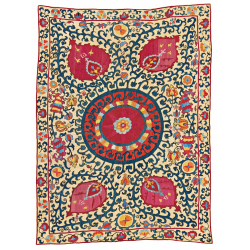
The wonderful thing about truly beautiful Suzanis is that you can look at them forever and always discover something new: sometimes a surprising flower here and there, a sudden shift in color scheme, the curve of a vine, or even zoomorphic creatures. We invite you to take a brief visual journey to find these creatures before you continue reading. The answers are below.
Central Asian Suzanis - the name derives from the Persian Suzandozi, meaning "needlework" - are among the most beautiful textiles of the Orient. One of the most prominent Suzani collectors, Ignazio Vok, wrote in the introduction to his collection catalogs: "Suzani are the most cheerful of all textiles." Who could disagree with that while admiring our embroidery?
The city of Samarkand is known, among other things, for its lush tendrils and central floral medallion. Enchanting colors accompany the dynamic design. The arrangement of a cross-sectioned flower in the center surrounded by four lengthwise-sectioned flowers is called a four-plus-one formation. This appears in Suzanis both in the field and in the borders, though rarely in such a monumental execution.
The composition is set in a garden, where we discover numerous different flower shapes. Particularly interesting are the two flowers to the right and left of the medallion with their boteh leaves.
If you paused for a moment earlier, you will likely have spotted a water jug, two little figures, and three birds - which undoubtedly represent peacocks.
Additional Samarkand Suzanis can be found in Christian Erber, "Suzani," nos. 22 and 54, as well as in Bausback, "Suzani," p. 39, and in Rippon Boswell, Auction A105, lots 8 and 93. Some of these wonderful embroideries also look quite good when viewed horizontally. This is also true of this exceptionally beautiful piece - give it a try!
Estimate: € 12000 - 180008 000 € -
Startpreis / Startingbid
30 000 €Lot: 32
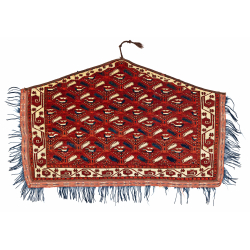
Tekke Bird Asmalyk137 x 86 cm (4' 6" x 2' 10")
Turkmenistan, ca. 1800
Condition: very good, good pile, scattered small repairs, minor small moth damage
Warp: wool, weft: wool, pile: wool
Published:
- "Asiatische Teppich- und Textilkunst 2", Eberhart Herrmann, 1990, plate 57
- Sotheby's New York, January 20 1990, Lot 65
- HALI 50, 1990, p. 169
- HALI 51, 1990, p. 99
- Grogan & Company Boston, "The Kaffel Collection", January 21 2024, Lot 168
Asmalyks were made in pairs to adorn the flanks of the bride's camel and feature their characteristic pentagonal shape. The small group of only about twenty known examples worldwide featuring depictions of birds ranks among the most sought-after Turkmen knotted textiles of all and fetches correspondingly high prices.
Our piece was sold on January 20, 1990, at Sotheby's New York as Lot 65 for $115,500; see HALI 50, p. 169, where it is, however, depicted in mirror image. HALI reported at the time on "rampant excitement in the Turkophile ranks," emphasizing in particular that the birds are oriented in different directions. Visually, this is certainly the most satisfying solution. Our asmalyk was, at that time, the fourteenth known example of this group, whose pieces are now scattered among museums and private collections.
The first known asmalyks of this type were acquired by the Russian ethnographer Samuil Dudin during two expeditions in 1900 and 1901 and are now housed in the Ethnographic Museum in St. Petersburg. The first detailed study of the twelve bird-motif Asmalyks known at the time can be found in Franses/Pinner, "Turkoman Studies I," 1980, pp. 114-121.
The little birds are perched on flowers depicted with varying degrees of detail. In addition, there is a subgroup - which includes the Dudin pieces - in which the birds stand on diamond shapes. An orange-red diamond-shaped grid covers the white, blue, and stone-green versions, enclosing the birds along with the "false" leaves. In other examples, these lines do not form a closed grid, making the flower and the bird perched on it much more clearly recognizable.
A rare opportunity to acquire one of these exceptionally rare and precious Turkmen works of art.
Estimate: € 50000 - 7000030 000 € -
Startpreis / Startingbid
8 000 €Lot: 33
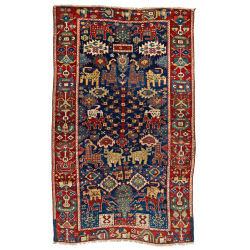
Exceptional South Caucasian Rug198 x 120 cm (6' 6" x 3' 11")
Caucasus, early 19th century
Condition: good for its age, mostly good pile, both ends incomplete, scattered small repairs, selvedges rebound
Warp: wool, weft: wool, pile: wool
This incredibly captivating animal rug, characterized by a wonderful play of colors, belongs to a small group that Michael Franses and Ian Bennett named "Animal Tree Carpets." See "Orient Stars," 1993, pp. 115-119, and HALI 73, pp. 90-99. At that time, the group comprised 19 pieces. They were produced across a vast region stretching from Eastern Anatolia to Azerbaijan, an area we now refer to as the "Golden Triangle." Some are structurally related, while others exhibit distinctly different weaving patterns; however, all are knotted symmetrically. What unites them is a shared formal language that interprets Safavid models in a wholly unique artistic style.
Our rug is dominated by a tree or shrub, accompanied by smaller green trees at the top and bottom. Beside and between them appear pairs of animals in combat. At the bottom, we see a yellow big cat attacking a red four-legged animal. Above that is a beast chasing a brown antelope, followed by a white animal - perhaps a leopard - pursuing another four-legged creature. After that, we likely see lions chasing antelopes, and finally, only fleeing four-legged animals. These are adorned with C-shaped motifs, as we know them from dragon carpets.
To be reasonably certain that these observations are accurate, one should consult several Safavid carpets for comparison. These include two small Kashan silk rugs - one at the Metropolitan Museum of Art in New York (Inv. 14.40.721) and another at the Musée des Arts Décoratifs - as well as the Rockefeller carpet described by Pope and Ackerman, no. 1182.
The carpet, which also belongs to this group and is illustrated as No. 2 in Schürmann's "Caucasian Carpets", apparently draws its inspiration from a piece in the Metropolitan Museum of Art (Inv. 14.40.710). Of particular importance to us, however, is that the somewhat difficult-to-interpret border of our rug finds its explanation in the Schürmann piece.
Estimate: € 14000 - 180008 000 € -
Startpreis / Startingbid
6 000 €Lot: 34
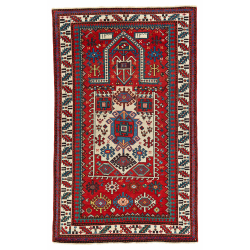
Small Kazak Prayer Rug150 x 91 cm (4' 11" x 3')
Caucasus, dated 1277 (1860)
Condition: very good for its age, scattered low pile, minor small repairs
Warp: wool, weft: wool, pile: wool
There is a very small group of closely related rugs, some of which feature silk in the weft and are dated to a very early period. One piece, illustrated in Ralph Kaffel's "Caucasian Prayer Rugs," no. 31, is dated 1807, for example. These rugs can be regarded as precursors to another small group dating to the mid-19th century. They feature a red ground with an almost always white field and a floating mihrab. A specimen from the Shirvan region is also illustrated in Kaffel as No. 70.
On almost all carpets in both groups, four interconnected rhombuses are found in the center, sometimes with leaves in between. Only our piece features a different motif in the center. The origin of the two squares in the upper corners of the white field can be clearly seen in a broad-shouldered example that was auctioned at Christie's on April 5, 2011, as Lot 11.
Another piece with a comparable niche design can be found at Christie's, May 17, 2005, Lot 50. Another prayer rug, also featuring the characteristic rhombuses, was auctioned by Lefevre in 1979 as Lot 43. A rug with rhombuses in the field, but with a rare blue ground, can be found in Rippon Boswell, Auction A98, Lot 72.
In our piece, the weaver appears to suggest a white medallion, which stands out particularly clearly in the lower section.
She also breaks up the basic square shape toward the top. For the center, she chooses a motif not unlike the ornaments found on some Shahsavan bags. Also noteworthy is the rugs superb color palette, which includes a deep aubergine.
Estimate: € 10000 - 150006 000 € -
Startpreis / Startingbid
5 000 €Lot: 35
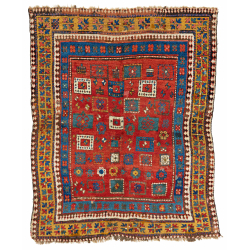
Early Karachoph Kazak196 x 160 cm (6' 5" x 5' 3")
Caucasus, mid 19th century or before
Condition: used, mostly good pile, corroded dark brown, sides and ends incomplete, several old repairs
Warp: wool, weft: wool, pile: wool
Some rugs just make you smile. You find yourself imagining the weaver saying to herself, "Enough with these ever-present, dominant octagons!" She then breaks down the classic Karachoph design into its individual parts and presents them as motifs of equal importance and similar size.
She begins at the bottom with a faithful reproduction of squares filled with double hooks, as seen on most Karachophs.
This is followed by a row of rosettes, which are typically used as filler motifs. The white and blue squares could be interpreted as representing the typical octagon, since their dotted border corresponds to the dotted field on which the octagon rests in classic Karachophs; see Eder, "Kaukasische Teppiche", nos. 28-33.
The two green medallions, pointed at the top and bottom, are, in contrast, a reference to the Fachralo region.
The checkerboard-like motifs shown in the upper section and at the top left then lead us back to the Karachophs.
There are certainly classic pieces with significantly more than four squares, but the central medallion is never omitted. For example, at Rippon Boswell on May 25, 2019, Lot 119, there was a beautiful Kazak that also features numerous squares, but it, too, has a medallion in the center, albeit a smaller one.
The majority of Karachophs with a medallion feature a vine leaf and calyx border, usually on a yellow ground and less commonly on a red ground. Our border, with four blossoms resembling arrowheads, by contrast, is quite rare.
A truly unique rug of village weaving artistry.
Estimate: € 7000 - 100005 000 € -
Startpreis / Startingbid
4 000 €Lot: 36
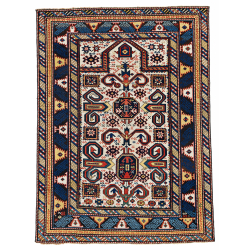
Perepedil160 x 118 cm (5' 3" x 3' 10")
Caucasus, second half 19th century
Condition: very good, corroded dark brown, scattered low pile but not worn, minor small repairs
Warp: wool, weft: cotton, pile: wool
White-ground rugs are rather rare in the Orient, but are more commonly found among prayer rugs from the northeastern Caucasus. In Ralph Kaffel's seminal work, "Caucasian Prayer Rugs", No. 47 features a piece from the Raoul Tschebull collection that is closely related to ours. A pretty little yellow secondary border with S-shaped motifs provides our rug with an additional frame; however, this feature is absent from the Kaffel piece.
In the text, Kaffel writes that there are two explanatory models for the design. One refers to ram's horns and dragons, while the other refers to Christine Klose's theory, which is based on Azerbaijani embroidery; see "The Perepedil Enigma," HALI 55, pp. 110-117. Kaffel notes, however, that Klose's approach offers far more verifiable evidence than any other.
This small group of rugs is quite uniform in design and generally features this unusual border. Kaffel sees it as a variation of the well-known "wine glass and leaf" border. His piece is "reliably dated to 1864," and our very well-preserved rug should not be far off from that date.
Our rug is 20 cm longer, which is also reflected in its appearance: it appears lighter and more spacious, as the main motifs have more room to unfold. A Perepedil prayer rug with the same pattern on a white ground was sold on January 15 of this year at Grogan & Company as Lot 3 for $9,375.
Estimate: € 6000 - 80004 000 € -
Startpreis / Startingbid
7 000 €Lot: 37
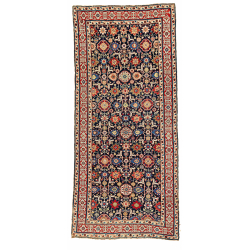
Early Baku365 x 160 cm (12' x 5' 3")
Caucasus, early 19th century
Condition: good for its age, low pile, both upper corners and the lower left corner restored, corroded dark brown, sides and ends partially damaged, scattered small repairs
Warp: wool, weft: cotton, pile: wool
This carpet, featuring the Afshan pattern, is one of the classics in the repertoire of Caucasian carpet weaving. Against a predominantly dark blue background lies a complex system of rosettes, fork-leaf motifs, palmettes, and star-shaped flowers, all connected by tendrils. As the 19th century progressed, weavers began to draw on individual motifs from this design and use them - for example, in the fork-leaf Kuba or the blossom Shirvan - to create new designs.
Equally classic is the Kufic border, usually set against a red background, which is accompanied by light-colored, floral-patterned secondary borders. Only a few stars are incorporated as additional fill motifs into the already dense pattern. However, in the fork-leaf motif slightly above the center, the weaver has taken some artistic liberty: four-legged creatures stand on the two upper forks, while we discover combs in the two lower ones. Carpets featuring the Afshan pattern and the closely related Harshang pattern are found across a vast region stretching from the Caucasus through Kurdistan to northern Persia. The main differences between the two patterns lie in the fact that in the Afshan pattern, the so-called "crab shapes" - which are actually fork-leaves - stand vertically rather than being arranged diagonally. Furthermore, the round rosettes are more prominently featured. An almost identical piece is illustrated in Grote-Hasenbalg, 1922, Volume 2, Plate 33. Another comparable piece can be found in Schürmann, "Caucasian Carpets", No. 96. Jim Burns shows an earlier form of the pattern in "The Caucasus - Traditions in Weaving," No. 3. In Serare Yetkin's "Early Caucasian Carpets in Turkey," a whole series of precursor pieces preserved in Anatolia are illustrated on plates 66-79; unfortunately, all but one are in black and white.
An unusually small Afshan was sold at Grogan & Company in Boston on January 29, 2023, as Lot 203 for 13,750 U.S. dollars. See also HALI 215, p. 168, for additional comparable examples.
Estimate: € 12000 - 160007 000 € -
Startpreis / Startingbid
7 000 €Lot: 38
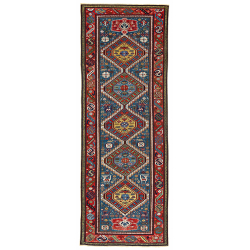
Fine Karagashli Shirvan294 x 107 cm (9' 8" x 3' 6")
Caucasus, second half 19th century
Condition: very good, mostly good pile, minor small repairs
Warp: wool, weft: cotton, pile: wool
These carpets, also known as "Pole-medallion Shirvan," typically feature five of the diamond shapes that give them their name. Here, the diamonds in the center alternate between yellow and blue and feature an endless knot alongside delicate motifs that resemble ears of grain. Toward the edges, they are connected by a white, jagged line, and at both ends, the pole terminates in a fiery-red palmette. In some of these pieces, the palmette appears rather flattened, which is why it is particularly lovely to see it fully unfold here.
The generous S-shaped border is borrowed from 17th- and 18th-century dragon carpets and is quite rare. Octagons and countless small horizontal S-shapes are incorporated into it as fill motifs. In Eder's "Kaukasische Teppiche" six Shirvan rugs of varying quality are illustrated, nos. 256-261. The first also features such a large S-border on a yellow ground. Another example is illustrated in Schürmann's "Carpet Bible," "Carpets from the Caucasus", no. 66. The overall design is also attested in some kilims from the Caucasus.
The deep-blue field contains a large number of diverse fill motifs. Endless knots appear alongside rhombuses, S-shapes, abstract knots, white octagons, and triangles arranged in amulet-like rows. Six white and dark-blue peacocks are particularly eye-catching. The depiction of camels, however, is truly extraordinary and rare. Each is accompanied by small four-legged animals.
Estimate: € 10000 - 150007 000 € -
Startpreis / Startingbid
7 000 €Lot: 39
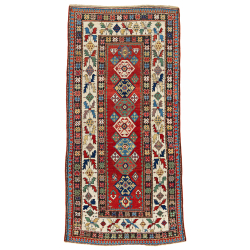
Early South Caucasian Rug288 x 137 cm (9' 5" x 4' 6")
Caucasus, first half 19th century
Condition: good for its age, mostly good pile, partially corroded dark brown, scattered small repairs
Warp: wool, weft: wool, pile: wool
At first glance, there appears to be nothing unusual about this attractive rug. However, upon closer inspection of the octagons on the beautifully abraded field, it becomes apparent that these do not actually belong to the customary repertoire of patterns but are evidently derived from kilims. In Yanni Petsopoulos's 1979 standard work on kilims, several flat-woven pieces from the Caucasus featuring comparable hexagons are published. Good examples for comparison can be found under numbers 301, 302, and 342, as well as in the band-patterned kilims nos. 310 and 318. However, this motif can also be found on the periphery of the Caucasus, in eastern Anatolia, particularly in the Erzurum and Kars regions; see ibid., nos. 269 and 270. Even a Persian example is found under no. 354. At the very bottom and top of the beautifully colored field of our example, however, two motifs appear in each case that clearly stem from the stylistic language of piled carpets. This creates a charming juxtaposition of different textile traditions. The expansive white main border demands special attention. Its design consists of four-leaf motifs and diamonds connected by fine rods. At the very bottom, there is initially a sort of "visual disruption": Apparently, the weaver was not quite sure at the beginning how she should develop the pattern. But the design soon gains confidence. The leaves are rendered increasingly expansive, with the two lower elements of each group of four hanging slightly downward. This gives the border - and ultimately the entire rug - a clear direction. The lively, almost playful design of the border stands in a charming contrast to the strict geometry of the field. To date, little has been written about the extent to which a single weaver might have produced both kilims and piled carpets. In the case of our piece, however, this seems a likely possibility: its weaver was exceptionally skilled at translating the design language familiar from flat weaving into the entirely different technique of knotted pile. It is precisely this effortless translation of kilim motifs into knots that makes this rug so remarkable.
Estimate: € 12000 - 160007 000 € -
Startpreis / Startingbid
3 000 €Lot: 40
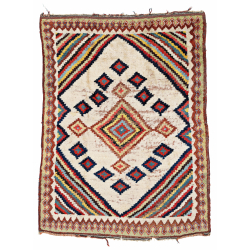
Double-Sided Qashqai Gabbeh214 x 158 cm (7' x 5' 2")
Persia, late 19th century
Condition: good, low pile in places, partially corroded brown, scattered small repairs, both kilim ends slightly damaged
Warp: wool, weft: wool, pile: wool
Early Gabbeh rugs are extremely rare, and we are especially pleased to present you with a double-sided example. The design is identical on both sides; only the color scheme differs. One might describe the light-colored side as a "summer rug" and the brown-red side as an "autumn rug."
The central medallion, with its attached diamond motifs, is, however, designed in nearly identical colors on both sides; only its border varies in color. The pattern is essentially derived from kilims, as we know them from the Qashqai and other South Persian tribes. An exemplary comparable piece can be found in "Vok Collection: Caucasus - Persia," Munich 1996, No. 104; Nos. 83 and 88 should also be consulted for comparison.
The colors of this extraordinary rug are of great beauty and harmony. The weavers working on either side of the loom naturally had to orient themselves by the pattern layout of the other weaver. This is particularly striking in the slightly "dancing" diamonds in the upper section: the small variations appear exactly mirror-inverted on both sides. It is precisely this detail that makes the creation process of the double-sided knotted rug immediately comprehensible.
A reciprocal crenellated border encloses the field; a comparable design can also be found in Vok No. 104. Writings have addressed both the defensive nature of these crenellated borders and the reciprocity of the pattern, which can also be interpreted as an invitation to cross the boundary. The result is a boundary line that, in a fascinating way, symbolizes both defensiveness and permeability.
Since Gabbehs were used, not least, as sleeping rugs, we are only too happy to accept the warm invitation of this magnificent piece.
Estimate: € 6000 - 80003 000 €