
Cart
0
Product
Products
(empty)
No products
Free shipping!
Shipping
0 €
Total
Product successfully added to your shopping cart
Quantity
Total
There are 0 items in your cart. There is 1 item in your cart.
Total products
(tax incl.)
Total shipping (tax incl.)
Free shipping!
Total
(tax incl.)
37
Early Baku
New
365 x 160 cm (12' x 5' 3")
Caucasus, early 19th century
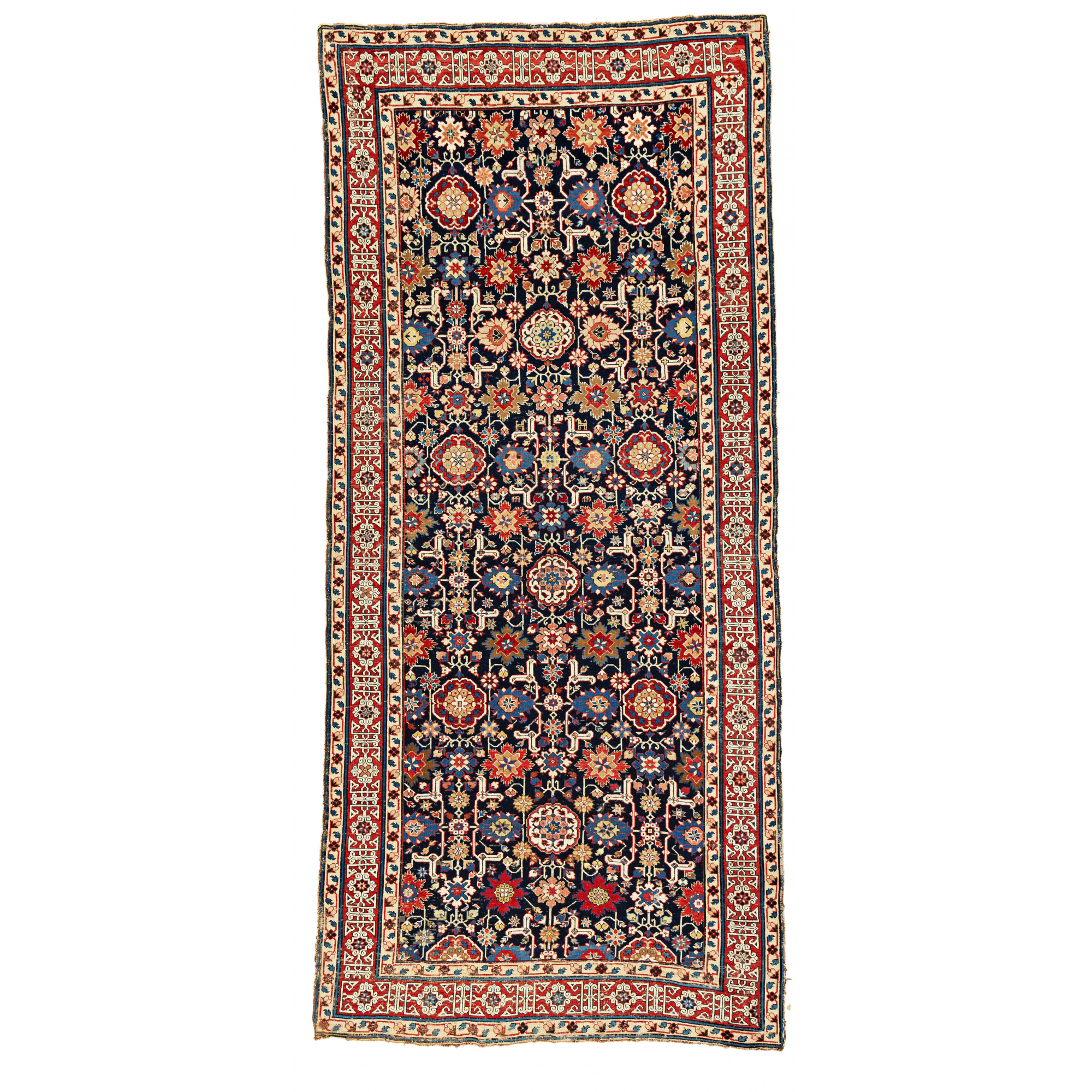
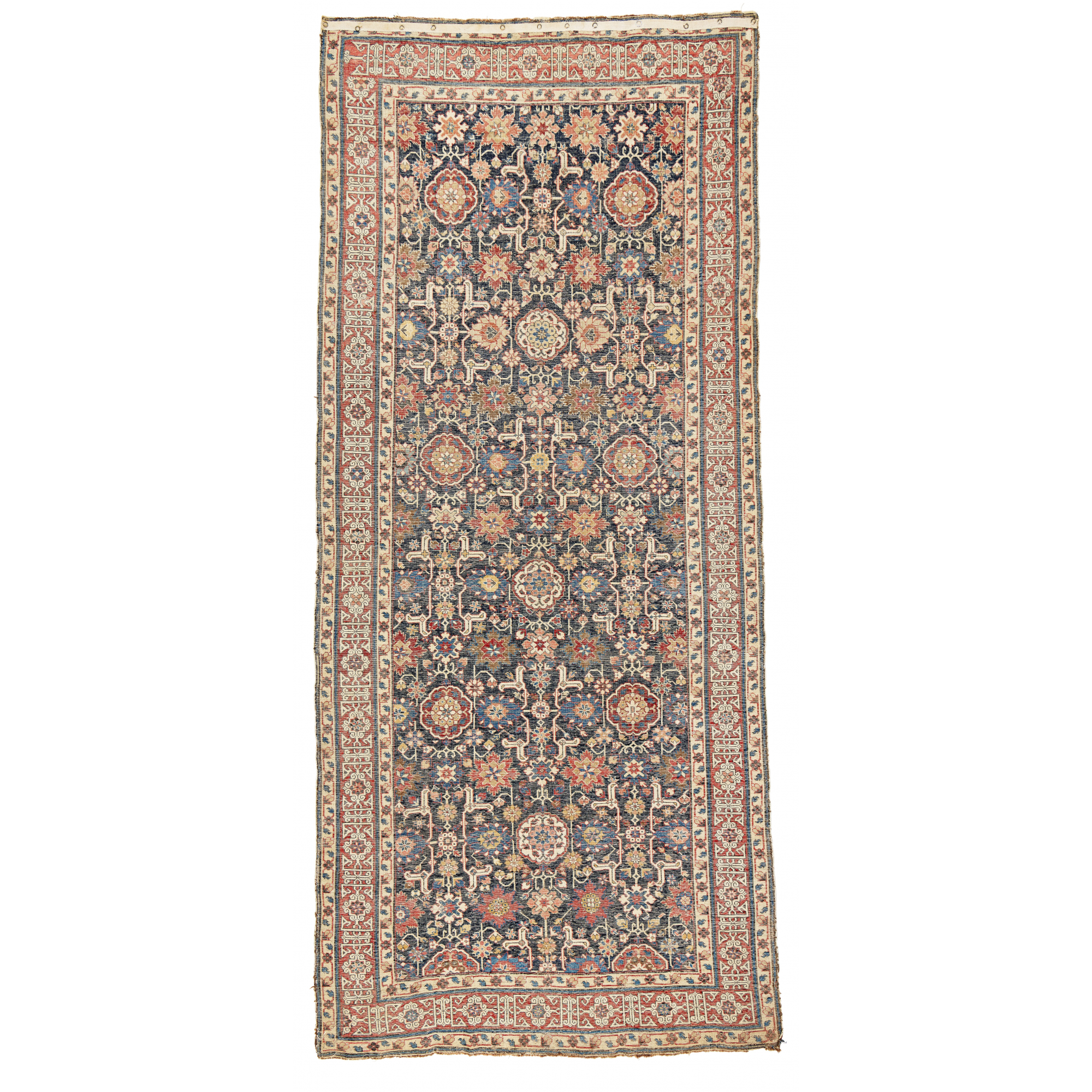
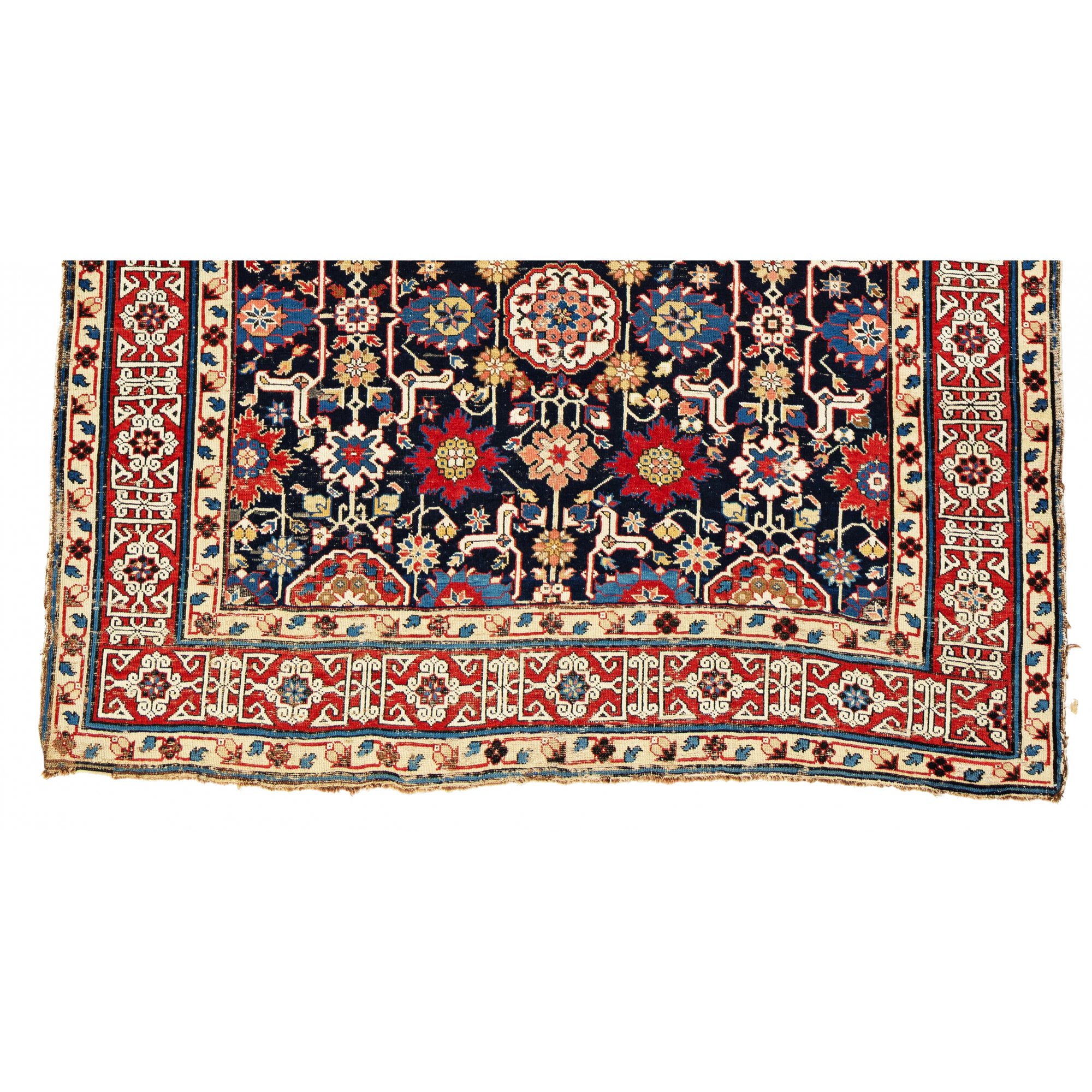
Condition: good for its age, low pile, both upper corners and the lower left corner restored, corroded dark brown, sides and ends partially damaged, scattered small repairs
Warp: wool, weft: cotton, pile: wool
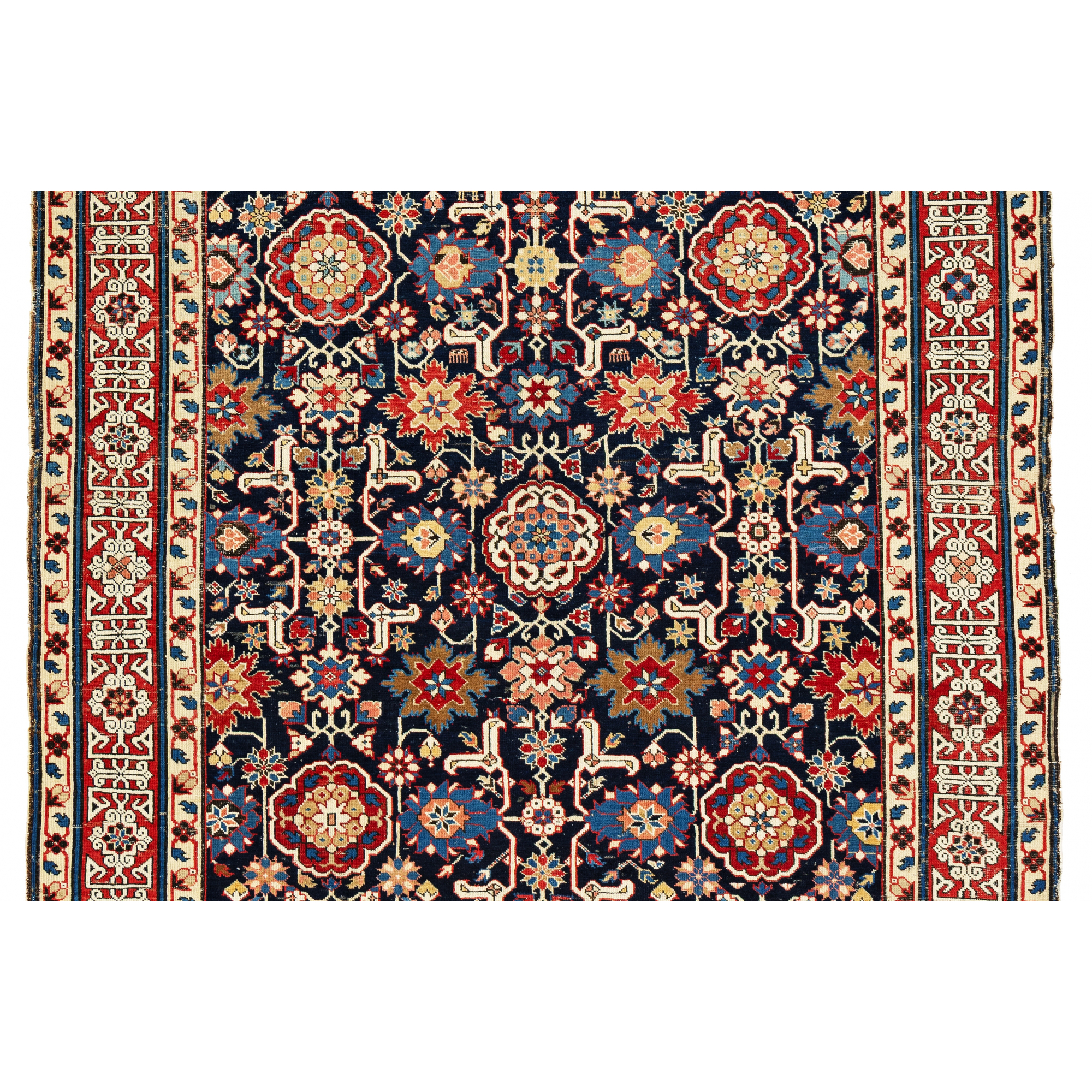
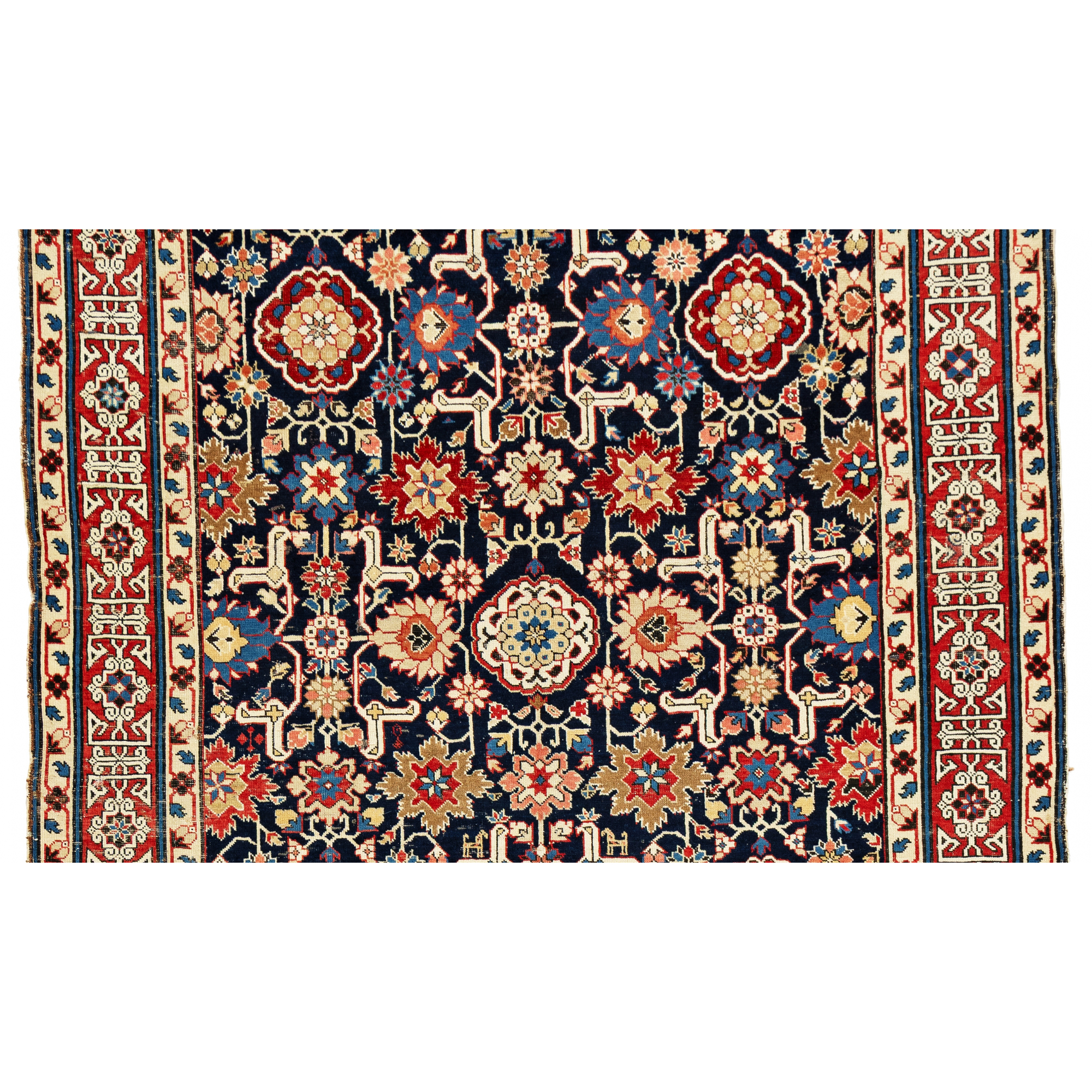
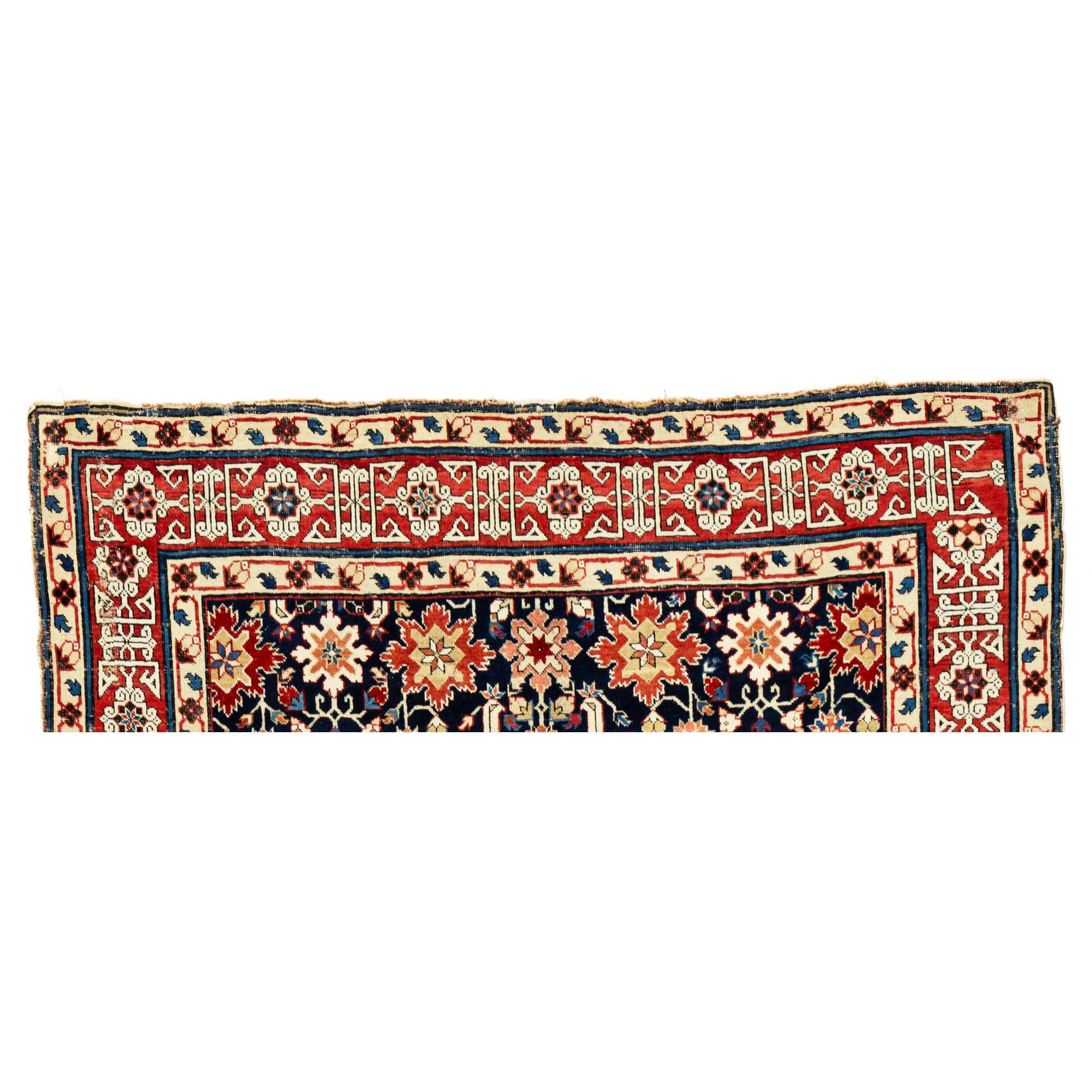
This carpet, featuring the Afshan pattern, is one of the classics in the repertoire of Caucasian carpet weaving. Against a predominantly dark blue background lies a complex system of rosettes, fork-leaf motifs, palmettes, and star-shaped flowers, all connected by tendrils. As the 19th century progressed, weavers began to draw on individual motifs from this design and use them - for example, in the fork-leaf Kuba or the blossom Shirvan - to create new designs.
Equally classic is the Kufic border, usually set against a red background, which is accompanied by light-colored, floral-patterned secondary borders. Only a few stars are incorporated as additional fill motifs into the already dense pattern. However, in the fork-leaf motif slightly above the center, the weaver has taken some artistic liberty: four-legged creatures stand on the two upper forks, while we discover combs in the two lower ones. Carpets featuring the Afshan pattern and the closely related Harshang pattern are found across a vast region stretching from the Caucasus through Kurdistan to northern Persia. The main differences between the two patterns lie in the fact that in the Afshan pattern, the so-called "crab shapes" - which are actually fork-leaves - stand vertically rather than being arranged diagonally. Furthermore, the round rosettes are more prominently featured. An almost identical piece is illustrated in Grote-Hasenbalg, 1922, Volume 2, Plate 33. Another comparable piece can be found in Schürmann, "Caucasian Carpets", No. 96. Jim Burns shows an earlier form of the pattern in "The Caucasus - Traditions in Weaving," No. 3. In Serare Yetkin's "Early Caucasian Carpets in Turkey," a whole series of precursor pieces preserved in Anatolia are illustrated on plates 66-79; unfortunately, all but one are in black and white.
An unusually small Afshan was sold at Grogan & Company in Boston on January 29, 2023, as Lot 203 for 13,750 U.S. dollars. See also HALI 215, p. 168, for additional comparable examples.
Estimate: € 12000 - 16000
Caucasus, early 19th century
Condition: good for its age, low pile, both upper corners and the lower left corner restored, corroded dark brown, sides and ends partially damaged, scattered small repairs
Warp: wool, weft: cotton, pile: wool
This carpet, featuring the Afshan pattern, is one of the classics in the repertoire of Caucasian carpet weaving. Against a predominantly dark blue background lies a complex system of rosettes, fork-leaf motifs, palmettes, and star-shaped flowers, all connected by tendrils. As the 19th century progressed, weavers began to draw on individual motifs from this design and use them - for example, in the fork-leaf Kuba or the blossom Shirvan - to create new designs.
Equally classic is the Kufic border, usually set against a red background, which is accompanied by light-colored, floral-patterned secondary borders. Only a few stars are incorporated as additional fill motifs into the already dense pattern. However, in the fork-leaf motif slightly above the center, the weaver has taken some artistic liberty: four-legged creatures stand on the two upper forks, while we discover combs in the two lower ones. Carpets featuring the Afshan pattern and the closely related Harshang pattern are found across a vast region stretching from the Caucasus through Kurdistan to northern Persia. The main differences between the two patterns lie in the fact that in the Afshan pattern, the so-called "crab shapes" - which are actually fork-leaves - stand vertically rather than being arranged diagonally. Furthermore, the round rosettes are more prominently featured. An almost identical piece is illustrated in Grote-Hasenbalg, 1922, Volume 2, Plate 33. Another comparable piece can be found in Schürmann, "Caucasian Carpets", No. 96. Jim Burns shows an earlier form of the pattern in "The Caucasus - Traditions in Weaving," No. 3. In Serare Yetkin's "Early Caucasian Carpets in Turkey," a whole series of precursor pieces preserved in Anatolia are illustrated on plates 66-79; unfortunately, all but one are in black and white.
An unusually small Afshan was sold at Grogan & Company in Boston on January 29, 2023, as Lot 203 for 13,750 U.S. dollars. See also HALI 215, p. 168, for additional comparable examples.
Estimate: € 12000 - 16000