
No products
Product successfully added to your shopping cart
There are 0 items in your cart. There is 1 item in your cart.
Masterpieces V There are 55 Lots.
-
Startpreis / Startingbid
6 000 €Lot: 1
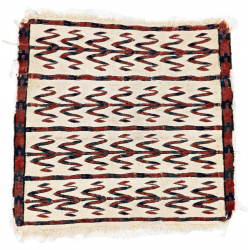
Fine Eagle Group II ? Okbash Fragment47 x 45 cm (1' 7" x 1' 6")
Turkmenistan, early 19th century or before
Condition: good for its age, low pile in places, sides and ends slightly damaged, a small tear in the upper right corner
Warp: wool, weft: cotton, pile: wool
Even very experienced auctioneers occasionally come across items that leave one speechless. The format, design, and technique here are a mystery. Where has one ever seen such beautifully curved little trees on a fine white background?
How was it made? Flat-woven? No. Piled? Yes, with symmetrical knots. Tent band? Hardly, since the pattern is closed at the top and bottom. Okbash? Perhaps.
The left side is damaged and no longer shows its original finish. This is where the triangles might have been located that, by sewing them together and joining the upper and lower edges, form the characteristic quiver shape.
However, the function of such okbash, as documented multiple times in older travel literature, was to protect the ends of yurt poles during transport on camels. Yet when one considers how much lighter and more flexible this piece is compared to typical okbash, one is almost tempted to revive this theory.
There is a small group of white-ground okbash that, in principle, display a similar but significantly more angular pattern. The best-known example is probably housed at the Textile Museum in Washington; see Mackie/Thompson, "Turkmen," 1980, no. 82. Two additional pieces are published in HALI 163, p. 97, and HALI 115, p. 150. None of them, however, has such soft and generous lines as our piece.
This brings to mind two embroidered asmalyks attributed to Kyrgyzstan in Felkersam's collection, as well as a piled version auctioned at Rippon Boswell on May 3, 1986, and the example at the Musée des Arts Décoratifs in Paris.
Perhaps we should simply put it this way: It is an enigmatic feast for the eyes.
Estimate: € 10000 - 150006 000 € -
Startpreis / Startingbid
4 000 €Lot: 2
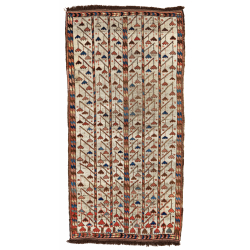
Small White-Ground Ersari166 x 84 cm (5' 5" x 2' 9")
Turkmenistan, mid 19th century
Condition: good, low pile in places, both ends restored, scattered small repairs
Warp: wool, weft: wool, pile: wool
White-ground rugs always have something special about them. From the central axis and the vertical bars on either side, small branches extend, from which heart-shaped flowers or leaves hang like lanterns. This gives the entire composition a distinct tree-like character. Only at the bottom does it seem that the weaver may have had something else in mind at the beginning. Immediately afterward, she finalizes her design, making the tree denser at the bottom but increasingly open toward the top.
Our rug is published in HALI 32, p. 51, on the occasion of an exhibition in Oakville, Ontario, Canada - though it is shown upside down. The exhibition took place in a private museum founded in 1980. The article expressed the hope that the collection would one day be housed in an official museum. This wish does not appear to have been fulfilled.
An Ersari prayer rug with similar branches and leaves was offered at Sotheby's; see HALI 151, p. 75. Other related examples can be found in HALI 2/2, p. 133, and HALI 2/4, p. 282, as well as a Beshir in HALI 181, p. 114. The latter is illustrated in an article by Ralph Kaffel, in which he analyzes price trends for prayer rugs from the Middle Amu Darya region.
However, the comparative pieces mentioned are all prayer rugs. Even an example in Bausback, 1987/88, p. 191, whose composition is already almost entirely tree-like, still bears so-called "ram's horns" at the very top, which mark its function as a prayer rug and, at the same time, the direction of prayer.
Ralph Kaffel had cataloged nearly one hundred of these prayer rugs in his archive. For our rug, however - which lacks a distinct prayer niche and in which the motif evolves into a free-form tree composition - one would be hard-pressed to find even ten comparable examples.
Estimate: € 6000 - 80004 000 € -
Startpreis / Startingbid
8 000 €Lot: 3
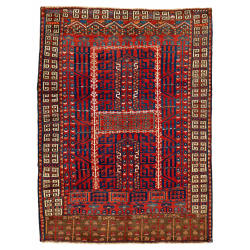
Saryk Ensi166 x 122 cm (5' 5" x 4')
Turkmenistan, mid 19th century
Condition: very good, mostly good pile, both lower corners slightly restored, upper end slightly incomplete, signs of use on the selvedges
Warp: wool, weft: wool, pile: wool with cotton highlights
Saryk-Ensi rugs are among the most sought-after Turkmen door rugs, second only to those of the Salors. They are highly recognizable, particularly due to their characteristic stripes featuring a vertical wavy line from which hook-adorned rods extend. These appear to the left and right of the main field; a modified form can also be found within the field.
A comparable piece was published as early as 1922 by Grote-Hasenbalg in Volume 3, Plate 87. This example, as well as an Ensi in Peter Hoffmeister's "Tent Band - Tent Bag" on Plate 34, differ from our piece primarily in the flowers rising along the outer edge of the field, whereas in our Ensi they are depicted hanging downward. The Hoffmeister rug was sold on June 3, 2023, at Rippon Boswell for 18,750; unfortunately, however, it had a main border that had been cut in half.
The central panel of our rug differs, however, in its internal design from all other Saryk Ensi known to us. Instead of the nearly universally used floral crosses, rows of four-pronged hooks appear here. Furthermore, the color scheme of apricot and stone green is particularly beautiful, and the design of the entire rug can be considered exemplary for the group.
Collectors also particularly appreciate the fact that the flowers of the side trees continue above the field. Unusual, however, is the almost playful manner in which the main border has been additionally adorned with zigzag lines.
Finally, a small irregularity in the lower left corner is particularly charming: apparently, the weaver suddenly realized that she would not have enough space to continue the pattern and, without hesitation, created a little more room. Such details lend a carpet its individuality and make the creative process immediately understandable.
In our opinion, this is one of the most beautiful known Saryk-Ensi rugs.
Estimate: € 14000 - 180008 000 € -
Startpreis / Startingbid
1 000 €Lot: 4
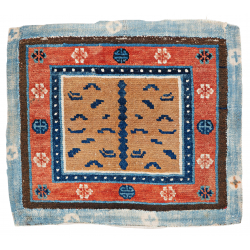
Tibet Tiger Sitting Rug61 x 73 cm (2' x 2' 5")
Tibet, ca. 1900
Condition: good, mostly good pile, fabric edging partially damaged, backed with fabric
Warp: wool, weft: wool, pile: wool
Tiger rugs are among the most sought-after rugs from Tibet and China. Their depictions range from highly naturalistic representations of the animal to complete abstraction, in which little more than individual stripes remain of the original tiger pattern. The oldest known tiger textile dates back to the 1st century B.C. and was found in Noin Ula.
Depictions of tigers can also be found on small sitting rugs. Probably the oldest known example is a highly naturalistic depiction from the second half of the 17th century, published by Eberhart Herrmann in "Asiatische Teppich- und
Textilkunst 2", no. 82. Another Chinese sitting rug featuring a highly abstracted tiger design is illustrated in HALI 49, p. 23, and was also in Herrmann's collection.
A Tibetan piece very similar to our rug can be seen in HALI 75, p. 122, in an advertisement by Spink. However, it lacks the Shou symbols for long life, which are arranged in the four cardinal directions on our specimen.
Two additional Tibetan seat mats, which may originally have formed a pair, are published in Franz Xaver Erhard and Thomas Wild, "Drumze," plate 16, as well as in "Woven Jewels: Tibetan Rugs from the Rutherford Collection," no. 102. Another pair featuring the tantric-inspired spine motif can be found in Rupert Smith's "Antique Tibetan Carpets," no. 26. These sitting rugs differ from our piece, among other things, in their T-shaped meander border.
We have also previously offered a sitting rug from this small group. It was sold in our Auction 26 as Lot 69 for 4,000.
Furthermore, this beautiful piece has retained its original Tibetan border made using the thigma technique - a particularly charming detail in a piece from this rare group.
Estimate: € 2000 - 30001 000 € -
Startpreis / Startingbid
2 000 €Lot: 5
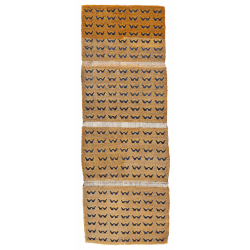
Unusual Tibet Tiger Rug147 x 54 cm (4' 10" x 1' 9")
Tibet, ca. 1900
Condition: very good, good pile, minor signs of use on sides and ends
Warp: wool, weft: wool, pile: wool
This extraordinary knotted rug, for which we know of no comparable example, features a highly abstracted tiger design. Without knowing the connection to the large Tibetan tiger rugs, the motif depicted would likely not be readily recognizable as a tiger skin.In Tibet, tiger skins and their textile representations were reserved for high-ranking persons, particularly princes and prominent abbots. See Mimi Lipton, "Tiger Rugs from Tibet," figs. 5 and 6. Also of interest in this context is a photograph in HALI 181, p. 66, showing a tiger pattern similar to that of the seat mat in our auction.
The flat-woven white stripes on our piece may make sense if one considers the rug as a kind of blank canvas. If one examines each of the four panels individually, this might provide a clue to its originally intended function.
Hanging, stuffed rugs or textile scrolls are frequently found at the entrances to Tibetan temples and monasteries.
An impressive example can be seen at the entrance to the White Palace of the Potala in Lhasa, where textile scrolls adorned with tiger patterns hang; see Mimi Lipton, fig. 9. A pair of comparable pieces is published in "Woven Jewels: Tibetan Rugs from the Rutherford Collection," no. 38. Another pair can be found in HALI 194, p. 75, in an article by Sandra Whitman, who describes these objects as scent pouches. However, such an interpretation poses a problem for our rug: if the individual panels were used for that purpose, the tiger patterns would be oriented vertically. It therefore seems equally plausible that the four panels were originally intended for the production of neck rolls. Although such Tibetan neck rolls are rare, their use is well documented. The definitive classification of this unusual piece must remain open. However, it is precisely the combination of a highly abstract tiger pattern, an unusual technical design, and a division into four panels - which was apparently intended from the outset - that makes this rug an extraordinary and possibly unique piece of woven art.
Estimate: € 4000 - 60002 000 € -
Startpreis / Startingbid
4 000 €Lot: 6
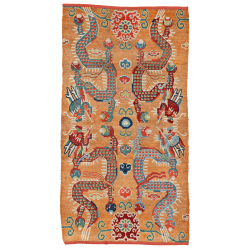
Tibet Dragon Rug160 x 88 cm (5' 3" x 2' 11")
Tibet, early 20th century
Condition: very good, good pile, minor small repairs
Warp: cotton, weft: cotton, pile: wool
Tibetan rugs featuring dragons are among the most sought-after pieces for collectors of rugs from the "Roof of the World." Unusually, four dragons are depicted here. Almost always, when four mythical creatures are found in this arrangement, they consist of two dragons and two phoenixes. These symbolize the emperor and the empress.
However, there are two rugs documented in the literature that are unusual for various reasons but also feature four dragons. One is a particularly large rug with four dragons circling a lotus-blossom medallion. A T-meander border frames this piece, which is illustrated on page 59 of Tom Cole's "Dream Weavers".
The other is a Ming-style rug featuring dragons among clouds, found in "Woven Jewels, Tibetan Rugs from the Rutherford Collection", no. 5. In this rug, the dragons are chasing a large flame pearl. The flame pearl symbolizes wisdom and enlightenment, and in most rugs of this type, the dragons are depicted chasing precisely this. In our rug and the Cole rug, they were apparently particularly successful at this, as each dragon holds four of them in its claws.
In this piece, magnificent lotus blossoms sit at both ends. Green tendrils extend from them, and one might think they are slightly imperfect. At the upper end, however, they are depicted in exactly the same way. So was this intentional, or was an attempt made here to cover up a "mistake"?
One could also imagine placing an identical carpet right next to it. Then the tendrils and the cut-off clouds would connect the two pieces. Perhaps this was exactly what was originally intended.
Estimate: € 6000 - 80004 000 € -
Startpreis / Startingbid
4 000 €Lot: 7
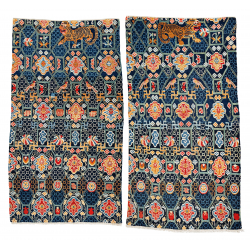
A Pair of Tibet Tiger Rugs158 x 88 cm and 164 x 86 cm (5' 2" x 2' 11" and 5' 5" x 2' 10")
Tibet, early 20th century
Condition: very good, full pile, minor signs of use
Warp: cotton, weft: wool, pile: wool
These pieces, which are likely unique, feature an extremely complex Chinese brocade design. It is well known that Chinese textiles have influenced certain Tibetan carpets. Consider, for example, Chinese medallions set against a background patterned with swastikas. However, such a complex weaving "tour de force" has hardly been documented to date.
Chinese fabrics have been preserved in Tibetan monasteries, and the pattern of octagons and squares used here has also been documented on several occasions. A good comparison is provided by a fabric published by Linda Wrigglesworth in
HALI 127, p. 133. In our rug, however, numerous elements have been altered or reinterpreted.
Various Buddhist and Chinese symbols of good fortune are incorporated into the squares. Working from the bottom up, we first see the treasure vase, above which are the endless knot and a Shou symbol, followed by the pearl. In the upper half appear a flame symbol, a butterfly, and bats.
Running through the center is a strip of rectangles adorned with swastikas, each containing a cloud symbol. In between are three-dimensionally rendered balls reminiscent of the play balls that the Fo dogs fight over on some Chinese carpets. Above another row of swastikas are naturalistically depicted birds.
Finally, at the very top comes the highlight: Each rug features a tiger, one facing right and the other left. The animals are depicted in a highly naturalistic style and likely allude to those tiger rugs on which the animals are shown roaming through bamboo. A piece of bamboo can even be seen beneath one of the left tiger's paws. This also explains the pattern in the adjacent fields - which initially appears asymmetrical - that likewise depicts bamboo.
An extraordinary example of weaving craftsmanship - and the fact that these rugs have been preserved as a pair is the icing on the cake.
Estimate: € 6000 - 90004 000 € -
Startpreis / Startingbid
14 000 €Lot: 8
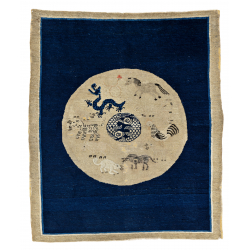
Chinese Zodiac Rug130 x 109 cm (4' 3" x 3' 7")
China, 19th century
Condition: good for its age, beige sections partially corroded, otherwise good pile, scattered small repairs
Published: "Asiatische Teppich- und Textilkunst, Band 5", Eberhart Herrmann, 1995, Tafel 108
Warp: cotton, weft: cotton, pile: wool
This unique little rug depicts the twelve animals of the Chinese zodiac. They follow one another in a clockwise direction, each representing one of the twelve years of the zodiac cycle. A new cycle begins with the Year of the Rat, which recurs every twelve years. At the same time, each year is assigned to one of the five elements - wood, fire, earth, metal, and water - as well as to either Yin or Yang. This combination forms the great Chinese calendar cycle of 60 years. It begins with the Yang Wood Rat and ends with the Yin Water Pig.
Particularly unusual are the two fish in the center of the rug. Fish appear relatively rarely on Chinese carpets and possess a multi-layered meaning in Chinese symbolism. Whether their depiction here is directly related to the zodiac or the 60-year cycle, or whether it holds an additional auspicious meaning, cannot be determined with certainty. Unfortunately, there is no inscription or other recognizable indication that would allow it to be attributed to a specific year.
As far as is known, only one other rug of this extraordinary type exists. It was part of the famous collection of the American art collector Thomas B. Clarke and was auctioned in January 1915 at the American Art Galleries in New York. The sale price is listed as $1,625 - an extraordinarily high sum for that time. The Clarke auction comprised a total of 585 antique Chinese carpets and related textiles and is considered one of the most significant early auctions of Chinese carpets in the United States.
Estimate: € 20000 - 3000014 000 € -
Startpreis / Startingbid
20 000 €Lot: 9
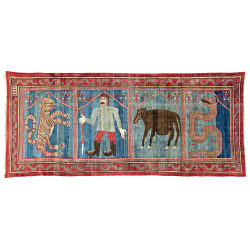
Silk Yarkand Saf398 x 171 cm (13' 1" x 5' 7")
East Turkestan, dated 1210 (1795)
Condition: good for its age, low pile in places, kilim ends slightly damaged, minor small repairs
Warp: silk, weft: silk, pile: silk
We may be stretching it a bit here, but without interpreting the date as originating from the Christian calendar, it is unlikely that anyone would have thought to date the carpet to the early 20th century. The quality of the colors and the knotting does not match what we believe we know about the late, degenerate, and heavily Chinese-influenced East Turkestan carpets.
In HALI 40, page 14, Parviz Tanavoli presented such a carpet, describing it as "one of the strangest carpets he had ever seen." He was able to determine that the carpet had arrived in Persia with Armenian emigrants shortly after World War I. He wrote that the man depicted resembled a Russian or Armenian officer from the late 19th century. In addition to dragons and tigers, he describes another animal as possibly a pregnant sheep, which could symbolize the man's wealth.
A few years later, on November 15, 1996, another example appeared at Nagel's, where it remained unsold at an estimated price of around DM 100,000. This carpet was later featured in HALI 184, pages 66-67, in the collection of the well-known dealer Oliver Hoare. On October 27, 2022, it was sold at Christie's as Lot 208 for £25,200, confusingly listed under the designation "Samarkand" (HALI 214, p. 165).
A third carpet from a Madrid collection had previously been sold at the same auction house for £43,750 (Christie's, October 24, 2019, Lot 262; HALI 204, page 124). Our specimen is thus the fourth known piece.
Parviz Tanavoli had already pointed out a possible astrological connection nearly 40 years ago, and indeed, all the animals depicted belong to the Chinese zodiac. Ultimately, however, we know hardly more today than we did back then.
There is evidence of an Armenian population in the oasis cities of East Turkestan dating back centuries. The patron may have commissioned one or more carpets in 1795 and, since he lived among Muslims, may have additionally received the Islamic date in a form he could read.
However, should a costume historian be able to prove that the clothing of the man depicted is unlikely for the period around 1800, we would have to fundamentally rethink our dating of East Turkestan carpets.
An enigmatic, impressive carpet of great quality and charm that will likely continue to puzzle future generations.
Estimate: € 30000 - 4000020 000 € -
Startpreis / Startingbid
4 000 €Lot: 10
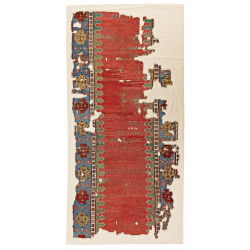
Early Caucasian Rug Fragment233 x 110 cm (7' 8" x 3' 7")
Caucasus, dated 1178 (1764)
Condition: fragment, sewn onto fabric
Warp: wool, weft: wool, pile: wool
This very old Caucasian rug with a Talish design is a rarity among Oriental rugs due to its monochrome field. In fact, empty space is generally considered taboo in Islamic art and is more commonly found in nomadic rugs such as Gabbehs. Nevertheless, there is a small group of carpets in the Caucasus - typically oblong in shape - that usually feature a blue field and a border with rosettes. The well-known American collector Jim Burns included a red-ground Talish as No. 35 in his book "The Caucasus - Traditions in Weaving." He wrote: "The reluctance of weavers from the Talish region to fill their main field with ornamentation has always been a true delight for collectors of Caucasian woven art." In the blue-ground pieces, a yellow reciprocal arrowhead border typically extends into the central field, whereas in the red examples, this border is predominantly green. Our fragment, however, features a reciprocal crenellated border, which in other pieces of this group frames the carpet toward the outer edge. Whether this was originally the case with our rug as well can no longer be determined due to its fragmentary condition. In the rug from the Burns Collection, there is a single, solitary dot in the otherwise empty field. Our piece also features such deliberately placed individual motifs: above the date is an amulet pendant, and further up, a second one. The main border also shows an interesting variation. In almost all other Talish carpets, four cube-shaped motifs are found between each pair of rosettes on the mostly white border. Our carpet differs here as well: two flowers appear between each pair of rosettes, while a line of diamonds connects the rosettes to one another. Another red-ground Talish is illustrated in an advertisement by the Kailash Gallery in HALI 42, p. 45; another example can be found in Eberhart Herrmann's article in HALI 58, p. 68. The Talish carpet, which at 574 cm is likely the longest known, also has a red ground and is housed in the Glencairn Museum in Bryn Athyn, Pennsylvania. Interestingly, Böhmer/Brüggemann's "Teppiche der Bauern und Nomaden in Anatolien" lists, as No. 25, a rug attributed to Central Anatolia with a very similar design.
Estimate: € 6000 - 80004 000 € -
Startpreis / Startingbid
5 000 €Lot: 11
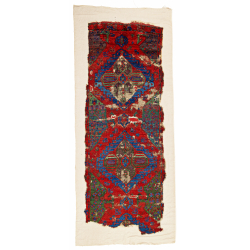
Karapinar Fragment310 x 121 cm (10' 2" x 4')
Turkey, 18th century
Condition: fragment, sewn onto fabric
Warp: wool, weft: wool, pile: wool
Wow, what a burst of color - a bold choice by the weaver! Yet the colors harmonize perfectly. In addition to the three rich primary colors, there's also aubergine and six tiny dots of pink. The deep green is especially charming. Anatolian dyeing art at its finest.
The pattern is familiar from other Karapinar carpets, but here, too, the weaver has taken some liberties. The closest match in terms of design is probably a piece from the Ayan-Gülgönen Collection, published in 17th-19th "Yüzyil Konya Kapadokya Halilari", Istanbul 1997, p. 81. It has only two medallions and features the same border. Formally, it is quite similar to our carpet, but its color scheme is entirely different.
A comparable piece, albeit one with a less daring color scheme, was exhibited by Thomas Murray at the ACOR in Boston in 2006; see HALI 146, p. 118.
The evolution of the pattern can be traced very clearly in a 17th-century carpet in the Vakiflar Museum; see Ertug, "Turkish Carpets," 1996, plate 100; also published in Balpinar/Hirsch, "Teppiche," 1988, plate 29, as well as in "Turkish Handwoven Carpets," 5/0554. There, the four-pass medallion also rests on a blue ground, and the characteristic pendants are already present. Although the carpet has only one central medallion, the inspiration for the green side motifs of our piece can be recognized in the corner designs. However, the green hooks appear there in an inverted form.
A nicely arranged variation of the pattern can be found in Kirchheim, "Orient Stars," 1993, p. 254.
And please also compare it to the other Karapinar in our auction.
Estimate: € 7000 - 100005 000 € -
Startpreis / Startingbid
6 000 €Lot: 12
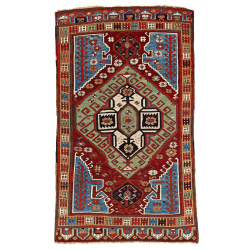
Karapinar232 x 136 cm (7' 7" x 4' 6")
Turkey, mid 19th century
Condition: very good, scattered low pile, minor small repairs
Warp: wool, weft: wool, pile: wool
Rugs from Central Anatolia featuring a central quatrefoil medallion, such as our example, appear both as single-motif pieces and in runner format. For the latter, see Brüggemann/Böhmer, " Teppiche der Bauern und Nomaden in Anatolien," No. 20. This piece, as well as a carpet featured in Eberhart Herrmann, "Seltene Orientteppiche VIII," No. 12, displays more red and a darker blue; see also Christie's, May 17, 2005, Lot 50, and a carpet from the Bogner Collection, Rippon Boswell, December 4, 2010, Lot 23. Pieces in this color scheme consistently feature white borders with the same pattern as our specimen.
An attractive subgroup, to which this rug belongs, features warmer colors, including a brownish-red that harmonizes beautifully with the apricot of the border, as well as a light blue in the spandrels. The panels at both ends, derived from Ottoman silk velvet yastiks, are particularly richly detailed here.
The quatrefoil medallion can be traced back to 17th-century Turkish carpets. A beautiful compilation of its various forms can be found in Michael Franses, "Orient Stars II," HALI Publications, 2021. See also the Dazkiri in our auction. In Michael Franses' book, Figs. 147 and 148 depict two pieces that provide an explanation for the design of the spandrels in our example; Fig. 150 shows the medallion on another rug with pendants.
Our rug is one of the most attractive examples of this group and is also in very good condition.
Estimate: € 10000 - 150006 000 € -
Startpreis / Startingbid
12 000 €Lot: 13
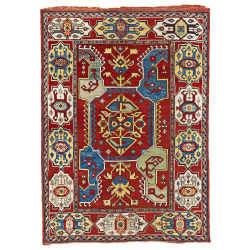
Early Unusual Bergama180 x 131 cm (5' 11" x 4' 4")
Turkey, 18th century
Condition: good for its age, mostly good pile, some professional restorations
Warp: wool, weft: wool, pile: wool
It is always fascinating to observe how rural weavers interpreted Ottoman workshop carpets in their own artistic style. A Star Ushak in the McMullan catalog, No. 68, depicts an urban carpet, while just one page later, under No. 69, the rural variant is shown. The latter is generally dated to the 18th through early 19th century. A specimen that more closely follows the classical Ushak carpets and features a distinctive border is dated by Michael Franses in "Orient Stars II" to 1500-1550. In this context, one should also consider Nos. 39 and 40 in Walter Denny's "Anatolian Carpets."
As early as 1922, such a carpet was published in Grote-Hasenbalg, Vol. II, Plate 19. In our carpet, the weaver borrowed the border from the so-called Transylvanian carpets. This border is significantly wider than those typically found in this group. As a result, the field is narrower, and the entire composition is more strongly focused on the main motif.
In comparison with the other examples, our carpet omits the triangular shapes extending into the field from the top and bottom and limits itself to the floral motif, which can also be found on the McMullan carpet No. 68. A carpet auctioned at Bukowskis last June displays the same configuration (June 11-13, 2025, Lot 349, SEK 105,000). Another comparable piece was offered at Rippon Boswell on November 29, 2025, as Lot 194.
Our carpet was described as "very attractive" in HALI 4/4, page 400, when it sold for £3,100 at Lefevre on February 26, 1982 - though it was pictured upside down there.
Estimate: € 20000 - 3000012 000 € -
Startpreis / Startingbid
4 000 €Lot: 14
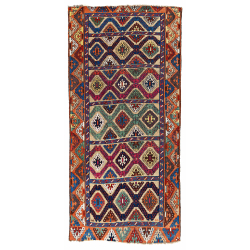
Sarkisla261 x 121 cm (8' 7" x 4')
Turkey, mid 19th century
Condition: good, scattered low pile, sides and ends incomplete, several old repairs
Warp: wool, weft: wool, pile: wool
The earliest known published rug related to our piece was published by Grote-Hasenbalg in 1922, in Volume 2, Plate 23. However, it differs from our example in that its field is not divided into individual panels.
In "Teppiche der Bauern und Nomaden in Anatolien" by Brüggemann/Böhmer (1980), Plate 90 depicts a rug with a comparable field division. It differs, however, in that the individual fields have different ground colors, whereas our rug has a uniform beige ground. Regarding a rug with an all-over pattern shown on Plate 89, Brüggemann notes that this color is extremely rare in rugs of this group. On Plate 91, he shows another version of the pattern in a staggered arrangement, of which several examples are known.
Our version, with or without a paneled division, also shows connections to kilims from Eastern Anatolia and Southern Persia. The border of our rug skillfully echoes the hook medallion of the field in a halved form, thereby achieving a completely different ornamental effect.
Surprisingly, two of these rather rare pieces with a coffered pattern can be found in the small catalog of the Rachel B. Stevens Memorial Collection, "Turkish Rugs," Textile Museum, Washington 1972, plates 5 and 6. No. 6 also uses the same border, but differs in that the individual fields are colored in different hues.
The wonderful colorfulness so characteristic of Eastern Anatolian rugs clearly sets this group apart from the products of other weaving regions. An interesting article by Brian Morehouse on Sarkisla and the patterns found there can be found in HALI 223, pp. 108 ff.
Estimate: € 6000 - 90004 000 € -
Startpreis / Startingbid
5 000 €Lot: 15
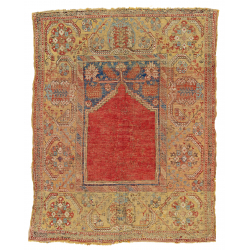
Transylvanian Prayer Rug156 x 123 cm (5' 1" x 4')
Turkey, 17th century
Condition: used, low pile, several old repairs, sides and ends partially damaged
Warp: wool, weft: wool, pile: wool
In Stefano Ionescu's seminal study, "The Transylvanian Heritage," Rome 2024, a similar piece with a finely detailed, stepped mihrab is published on page 204, bottom right. The unusual inner secondary border is also visible there. However, only one of the two spandrels above the niche is blue. In the majority of these prayer rugs, the spandrels are white, beige, or red.
A bold Ottoman border featuring palmettes, flowers, and lanceolate leaves encircles the field. The corner designs are well executed, which cannot be said of all Transylvanian rugs.
In Transylvania itself, where the world's largest collection of these rugs has been preserved in churches, there are ten prayer rugs featuring a finely detailed stepped mihrab and this type of Ottoman border; see Ionescu, p. 322.
On the reverse side, the use of so-called "lazy lines" can be observed. These occur when, during knotting, the weaver does not work row after row of knots across the entire width of the carpet, but instead works in sections, building up small "piles" of knots in front of her. In this piece, such a "pile" is clearly visible in the red mihrab. Red wefts were also used in the central field, presumably to enhance the color impression of the red ground.
At the legendary Bernheimer auction at Christie's London on February 14, 1996, Lot 176 - a carpet comparable even down to the secondary borders - was sold for £10,000.
Estimate: € 8000 - 120005 000 € -
Startpreis / Startingbid
10 000 €Lot: 16
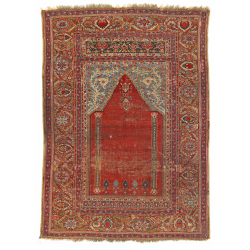
Early Ghiordes Prayer Rug162 x 117 cm (5' 4" x 3' 10")
Turkey, ca. 1700
Condition: good for its age, low pile in places, some small old repairs, both ends slightly damaged
Warp: wool, weft: wool, pile: wool
Turkish prayer rugs featuring depictions of columns document an unbroken tradition of artistic creation spanning centuries. Ranging from Ottoman court art to nomadic and village-made pieces, they date from the 16th to the 20th century.
One of the "great-grandfathers" of this type is housed in the Museum of Islamic Art in Berlin, Inv. No. KGM 1889,156 (Ionescu, "The Transylvanian Heritage," p. 209). The first striking difference is that the horseshoe-shaped mihrab has given way to a gable motif. A panel above it can be seen on the same side of another carpet, which also dates from the 16th century.
The design's further development then led to the so-called Transylvanian column prayer rugs and ultimately to the coveted Ghiordes pieces. The densely patterned border featuring palmettes, sickle-shaped leaves, and rosettes, as well as the consistent use of red weft threads, identifies our carpet as a Basra Ghiordes. This has nothing to do with the Iraqi port city but is simply a common trade name used to designate this subgroup.
In contrast to the courtly pieces, Transylvanian carpets and Ghiordes works feature, in addition to palmettes, an increasing number of secondary motifs such as vases and bouquets. The beautiful large flowers along the lower edge of our carpet are quite unusual.
Some comparable examples can be found in Grote-Hasenbalg, Volume 2, Plate 9; Zipper, "Anatolian Carpets," No. 39; and Aslanapa, "One Thousand Years of Turkish Carpets," Plate 134. A comparable rug, though with a light-colored border, sold at Christie's on October 9, 2006, for £22,800. A specimen very similar to ours was offered at Sotheby's on November 27, 2019, as Lot 81, and also features the beautiful roses in the upper panel.
Estimate: € 15000 - 2000010 000 € -
Startpreis / Startingbid
7 000 €Lot: 17
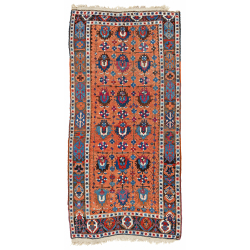
East Anatolian Kurdish Rug268 x 134 cm (8' 10" x 4' 5")
Turkey, first half 19th century or before
Condition: good, mostly good pile, dark brown partially corroded, scattered small professional restoriations, slight signs of use
Published: "Seltene Orientteppiche IV", Eberhart Herrmann, 1982, plate 12 and "Teppiche aus dem Orient", Ulrich Schürmann, 1979, p. 81
Warp: wool, weft: wool, pile: wool
The design of this extremely rare rug initially presents us with a few puzzles. In our search for comparable pieces, we first came across an example published by Alan Marcuson in HALI 2/2, p. 72. It features the same color scheme, a comparable border, and the characteristic palmettes with horizontal bars. However, this piece is less precisely executed, and in the center, slightly distorted palmettes - alternately facing right and left - appear in a staggered arrangement.
A few years ago, another piece from the Naim Attallah Collection appeared at Sotheby's, auctioned on October 27, 2021, as Lot 271. A rug from the Keir Collection, published in "Islamic Carpets and Textiles", No. 70, shows the horizontally and vertically oriented palmettes already connected to one another; the border also resembles the lower border of our piece.
"This carpet is a caricature of Herat and Indo-Isfahan carpets with their in-and-out, up-and-down arranged palmettes, which have been found throughout Kurdistan and the Caucasus since the 17th century," wrote Charles Grant Ellis regarding a piece in "Early Caucasian Rugs," Plate 37. As a further point of comparison, he cites a specimen in Kurt Erdmann's "Der orientalische Knüpfteppich," No. 114.
Well, with all due respect to his opinion - today, it is precisely such independent, village-style interpretations that are particularly prized. Some of these rugs are grouped under the so-called "Golden Triangle" group, which Alberto Levi discusses in detail in HALI 214, pp. 100 ff. In particular, the pieces illustrated there, nos. 23, 24, and 25 - the latter being the specimen published by Marcuson - belong to this group, as does no. 26 from the Weise Collection; see also Austria Auction Company, Masterpieces IV, Lot 25.
Estimate: € 10000 - 150007 000 € -
Startpreis / Startingbid
18 000 €Lot: 18
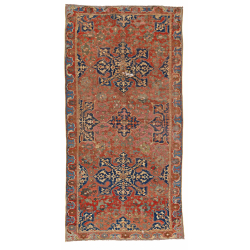
Star Ushak345 x 173 cm (11' 4" x 5' 8")
Turkey, 17th century
Condition: used, low pile, sides and ends incomplete, scattered small holes, several old repairs and reweavings
Warp: wool, weft: wool, pile: wool
Ushak carpets were produced in the Ottoman Empire beginning in the 15th century and appear in European paintings as early as the first half of the 16th century. The best-known example is undoubtedly the painting by Paris Bordone in Venice, which was commissioned in 1534 and completed in 1545.
The most common are medallion Ushaks, which were produced from the 15th through the 18th century. Star Ushaks, on the other hand, were produced only until the 17th century. They feature an endless repeat pattern of eight-pointed stars and rhombuses; the ground, usually red, is covered with floral tendrils. The design was developed by Ottoman court artists, who were well acquainted with Persian carpets of the period.
The most beautiful carpet of this type is certainly the one illustrated in McMullan, "Islamic Carpets," 1965, no. 67.
One difference between that carpet and the present example - as well as almost all other star Ushaks - is that the McMullan carpet shows more of the medallions' cut edges, which further enhances the impression of an endless repeat.
The most common border on star Ushaks features cloud bands. The so-called Gothic border, which our piece also features,
is likewise found on a Star Ushak that we successfully sold on September 16, 2014, for 122,000 and which is now in the Arkas Collection in Izmir; see HALI 216, p. 104, right.
Estimate: € 30000 - 4000018 000 € -
Startpreis / Startingbid
8 000 €Lot: 19
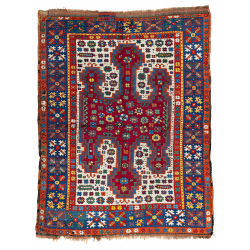
East Anatolian Kurdish Rug (Marash)181 x 144 cm (5' 11" x 4' 9")
Turkey, first half 19th century
Condition: good for its age, mostly good pile, sides and ends slightly damaged, a small hole in the center, some old repairs
Warp: wool, weft: wool, pile: wool
This wonderful rug exemplifies the synergy of rural and village rug-making in the most exquisite way. The imposing central motif points, on the one hand, toward its eastern neighbors in the Caucasus - the Sevan Kazaks - and, on the other, westward toward prayer rugs, such as those of the Yörük, which feature a head-shaped mihrab. These, in turn, draw their inspiration from the so-called re-entrant or Bellini carpets. However, the examples mentioned so far have only one "head" on each side and are not tripartite. This tripartite structure leads us to Western Anatolia, where we also find it, often in red on a white ground. Perhaps the most beautiful example is the one illustrated by McMullan on Plate 92.
For our Eastern Anatolian specimen, the weaver evidently had a very clear idea of what she wanted to depict. It is rare to see fill motifs arranged so strictly, almost like lines of writing. Much less varied, though equally strictly ordered, rows of motifs can also be found on the McMullan piece.
These rugs with mirrored gable niches can be traced back further to the Transylvanian niche rugs and their predecessors. For comparison, see also two rugs in Walter Denny's "Anatolian Carpets", nos. 51 and 52, as well as a niche rug attributed to Ladik in Schürmann's "Teppiche aus dem Orient", page 75.
Things get really exciting now when we turn our attention southward from Eastern Anatolia to Lebanon. In the "Exhibition of Oriental Carpets," which took place in May 1963 at the Nicolas Sursock Museum in Beirut, Plate 86 depicts a specimen that bears a striking resemblance to ours. The main border, the stepped, head-shaped mihrabs, and the comparable fill motifs show a clear kinship; however, the mihrabs there are not mirrored downward.
This rug, as well as a related example in "Prayer Rugs" from 1974, Plate XLIII, originate from the village of al-Fakiha in the Bekaa Valley in Lebanon. Unfortunately, both are depicted only in black and white.
Estimate: € 14000 - 180008 000 € -
Startpreis / Startingbid
8 000 €Lot: 20
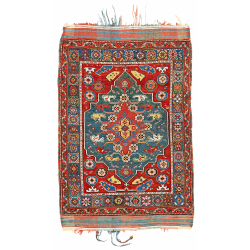
Dazkir196 x 130 cm (6' 5" x 4' 3")
Turkey, mid 19th century
Condition: very good for its age, mostly good pile, signs of use at the kilim ends, minor small repairs
Warp: wool, weft: wool, pile: wool
In this wonderful rug from southwestern Anatolia, we not only find fascinating traces of past centuries, but it also exhibits a technical peculiarity. The color palette is quite typical of the small town of Dazkiri and its surroundings.
The rug's overall layout immediately brings to mind Transylvanian pieces with double niches. Perhaps the closest match is Cat. 247 on page 173 in Stefano Ionescu's "The Transylvanian Heritage". Transylvanian rugs usually feature a red medallion, sometimes a white or beige one, but almost never a blue or green one. Otherwise, the entire range of patterns can be found in the eight rugs shown on pages 172 and 173.
We have already discussed the quatrefoil medallion in the center in connection with the Karapinar rug in this catalog, and it is fascinating to see how different the artistic interpretations are across the various regions of Anatolia. Without knowledge of Transylvanian rugs, one might never have guessed that the blue-and-yellow pendants at the tips of the medallion represent a sickle-shaped leaf and a flower, respectively. On the other hand, the carnations protruding into the green field and the white rosette flowers are depicted in a manner very similar to that of the original models.
In the Orient, when one wished to commission a truly special carpet with traditional designs, special materials were also used for the base weave. Four different colors were used for the warp of our rug - an effort that can only be fully appreciated at the ends. Thankfully, these have been preserved in our exemplary piece.
A rug with an almost identical pattern was auctioned at Rippon Boswell on November 18, 2006, as Lot 123 for 24,000. It was dated 1262 AH, corresponding to 1846/47 AD, and also featured an inner secondary border.
Estimate: € 12000 - 160008 000 €