
No products
Product successfully added to your shopping cart
There are 0 items in your cart. There is 1 item in your cart.
Masterpieces V There are 55 Lots.
-
Startpreis / Startingbid
8 000 €Lot: 41
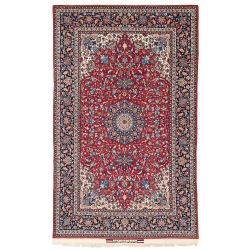
Isfahan Seirafian, probably by Haj Agha...238 x 145 cm (7' 10" x 4' 9")
Persia, mid 20th century
Condition: very good, full pile, slight signs of use on the fringes
Signature: "Baft Iran Isfahan Seirafian"
Warp: silk, weft: silk, pile: wool
The famous Seirafian workshop was founded in 1940 and produced Persian carpets of outstanding quality. The founder, Haj Agha Reza Seirafian (1881-1974), was originally a banker but had previously gained experience in the production and trade of carpets. All seven of his sons produced carpets under their own names. Two of his daughters also devoted themselves to the business.
An exceptionally complex radiating medallion dominates the field, accompanied by two smaller medallions with a similar composition. Radiating from these, a white spiral scroll pattern covers the red field. In the finest Safavid tradition, another blue scroll pattern lies beneath it, lending the carpet remarkable depth. To the right and left of the medallion, the two patterns are connected by a palmette.
The white lance-shaped leaves at the forks of the white tendrils deserve special attention. They are characterized by a captivating, complex elegance. The white ground on which the imposing medallion rests is bordered by subtle corner spandrels that are delicately set apart from the white field, yet are themselves connected to the medallion by voluminous vase motifs.
The border echoes the motifs of the central field with exuberant opulence, with a particular emphasis here on the blue wave-like tendrils. A masterpiece of Persian weaving on a silk ground, for which only one word is truly needed: perfection.
Estimate: € 15000 - 200008 000 € -
Startpreis / Startingbid
8 000 €Lot: 42
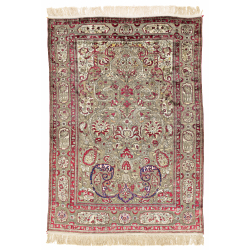
Silk Kashan Mohtashem Souf with metal brocade188 x 133 cm (6' 2" x 4' 4")
Persia, ca. 1900
Condition: very good, full pile, minor small repairs
Warp: silk, weft: silk, pile: silk with metal brocade
In Safavid Persia in the early 17th century, weavers began to make their already extremely luxurious silk carpets even more exquisite by incorporating metal brocade. This technique was revived in the 19th century by Persia's finest workshops and is known as "Souf." The ground is woven with metal threads, while the design is knotted in silk. As a result, the pattern stands out from the precious silver ground not only visually but also in a three-dimensional way due to its pile.
Large-format carpets of this type often feature medallions or spiral scrolls, whereas the smaller examples frequently depict a prayer niche. Most of the latter feature tree or vase motifs. The combination of a niche and scrollwork, on the other hand, is rather rare.
Palmettes and boteh motifs are connected by a dense network of scrollwork, behind which the niche recedes slightly.
This effect is counterbalanced by the architectural design featuring suggested columns topped by vases. Note also the unusual square knot patterns in the lower center of the field.
Well hidden, we discover two white fish with red eyes in the lower corners. Animals are also found in the borders. The birds in the red secondary borders are quite obvious. More difficult to spot are the bunnies and ring-necked doves in the main border, whose octagonal and coffered design also draws on Safavid models.
A carpet with this rarer border was featured in Christie's "Oriental Rugs and Carpets," October 10, 2008, Lot 173.
Estimate: € 12000 - 160008 000 € -
Startpreis / Startingbid
5 000 €Lot: 43
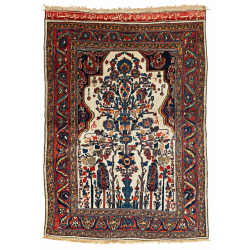
Bakhtiari Khan with Inscriptions208 x 148 cm (6' 10" x 4' 10")
Persia, ca. 1900
Condition: good, mostly good pile, scattered small repairs, signs of use at the kilim ends
Inscription: "Farmaesh Djenab Djalalatmahab Aghae Sultan Mohammad Khan Humayoun Dam Eqbala Al Ali Amal Bakhtiari"
Warp: cotton, weft: cotton, pile: wool
In the small group of inscribed Khan carpets, a tree is often depicted at the center, accompanied by vases. The composition of our piece is less common, as it gives prominence to the flower vase, while trees appear alongside it in a charmingly suggested garden landscape.
A pair of birds chirps from the tops of the cypress trees, which rise from a flower bed. Right next to the vase, we find slender trees of paradise that seem to bear all the fruits of the earth. Their growth, however, is hindered by the magnificent bouquet of flowers, which stands out beautifully against the rare white background.
Upon closer inspection, we discover small red triangular amulets at the top of the mihrab's shoulders. These beautifully illustrate the nomadic tradition of the Bakhtiars, who had become influential and prosperous toward the end of the 19th century.
Ian Bennett's two-part article "Carpets of the Khans" in HALI 43, pages 40-51, and HALI 44, pages 18-29, vividly recounts the history of Khan carpets. A carpet that is almost identical to our piece - though slightly fuller and not quite as airily rendered - is shown in black and white on page 47 of the first part. This carpet - or an identical counterpart - was sold 20 years ago, on April 5, 2006, at Sotheby's London as Lot 70.
Two years earlier, a Tree of Life carpet sold for 26,400 at Rippon Boswell on May 15, 2004, as Lot 100. In the Zaleski auction held at the same auction house on September 30, 2019, another example was sold as Lot 83 for 20,910.
Estimate: € 8000 - 120005 000 € -
Startpreis / Startingbid
4 000 €Lot: 44
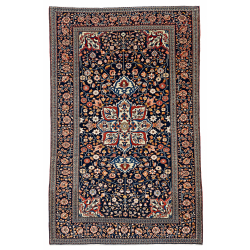
Kashan Mohtashem198 x 138 cm (6' 6" x 4' 6")
Persia, early 20th century
Condition: very good, full pile, minor small repairs, slight signs of use at the top
Warp: cotton, weft: cotton, pile: wool
A small, exquisite rug featuring a prominent medallion and large pendants. In contrast, the corner motifs are significantly more subdued, leaving all the more space for the beautiful floral decoration in the field. A straight white line runs from the palmettes of the medallion to the lush bouquets at the top and bottom, thereby forming a striking central axis.
Arranged around the small central flower of the medallion are four iris rosettes, whose reddish-brown stems form the basis for the quatrefoil shape above them.
In the Orient, it is rather unusual to design the border in the same base color as the field. This may have been done at the specific request of the client. In the border, flowers depicted head-on and at an angle alternate, embedded in a dense network of tendrils. The pattern is elegantly extended around the corners, thereby leaving room for an unusual additional corner design.
The meticulous craftsmanship of this rug is also evident in the barely perceptible contour line around the medallion, which is only one knot wide. A fine white line woven into the field achieves the same effect in the white, quartered corner medallions.
It is easy to imagine that this exquisite piece once adorned a lady's boudoir.
Estimate: € 6000 - 80004 000 € -
Startpreis / Startingbid
8 000 €Lot: 45
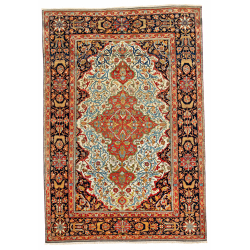
Kashan Mohtashem200 x 138 cm (6' 7" x 4' 6")
Persia, late 19th century
Condition: very good, mostly good pile, minor signs of use
Warp: cotton, weft: cotton, pile: wool
At first glance, the warm colors of this elegant rug are immediately striking. The muted apricot and reddish-orange tones harmonize beautifully with the light blue tendrils on the white central field.
The central medallion features not just one, but two pendants, from which fork-shaped leaves rise. The deep-blue, truncated corner medallions are just as large as the central medallion and thus almost merge with it.
As you delve into the white field with its delicate tendrils, you discover an enchanting lightness in the interplay of colors and motifs. It is precisely this light, open field that lends the otherwise powerful composition its special elegance.
The unusual main border leads us to a rug published in the book by Galerie Pakzad in Hanover, "Persische Knüpfkunst" (1978), fig. 173. Although this example is somewhat more subdued in color, it features a Mohtashem with a comparable border of star-shaped flowers and bowls from which lanceolate leaves emerge.
The delicate reciprocal crenellations of the accompanying bands are also found there. With their filigree design, they help the loosely arranged secondary borders to visually frame the imposing main border and connect it to the field.
A masterful piece of work of great elegance and creative confidence, the quality of which is rarely found today.
Estimate: € 12000 - 160008 000 € -
Startpreis / Startingbid
8 000 €Lot: 46
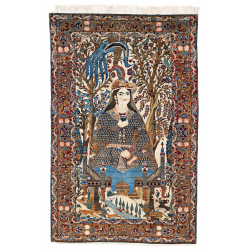
Kashan Mohtashem Relief Pictorial Rug237 x 152 cm (7' 9" x 5')
Persia, early 20th century
Condition: very good, full pile, minor small repairs at the top, slightly stained on the back
Warp: cotton, weft: cotton, pile: wool
To some, the figurative depiction of people on Persian carpets may seem strange at first, given the common assumption that Islam prohibits images. The reality, however, is far more nuanced. Since the 16th century, Shi'ite Islam has been the state religion of Persia, and figurative representations have continued to play a significant role in Persian art. Velvets, embroideries, and other textiles dating back to the Safavid period have been preserved, depicting figures from mythical tales and Persian poetry. Under European influence, oil painting eventually gained great significance in the 18th and, especially, the 19th century during the Qajar dynasty.
On our carpet, an elegant lady, apparently drinking wine, sits on a regal throne crowned by minaret-like turrets. She wears a dress made of Kani fabric - the Persian variant of cashmere weaving - as well as a precious cloak adorned with animal motifs that falls from her head. Over this, she wears a peacock-feather headdress in the shape of a boteh, which indicates her high, possibly royal, rank. Above her - amusingly depicted upside down - is a peacock in a tree. Trimmed cypress trees rise from a paradisiacal garden in which fish, gazelles, goats, and a winged lion frolic peacefully together.
A carpet with an almost identical design was advertised by the Kaminski auction house in HALI 165, p. 13. There, however, the depicted figure is not seated on a throne but in front of a small table on which there is another bottle and a bowl of fruit. In the description from that time, the figure is identified as Noor Ali. This identification, however, seems questionable, as Noor Ali is depicted as a dervish and usually appears with a pipe in such portraits. It is therefore impossible to determine with certainty who is actually depicted on our carpet. The courtly setting, the throne, and the elaborate peacock feather adornments, however, clearly point to a high-ranking figure. Regardless of the figure's identity, the sophisticated design and masterful weaving of this wonderful carpet impressively attest to the artistry of Persian weavers.
Estimate: € 12000 - 160008 000 € -
Startpreis / Startingbid
4 000 €Lot: 47
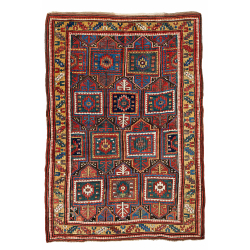
Saujbulag208 x 140 cm (6' 10" x 4' 7")
Persia, second half 19th century
Condition: very good, full pile, corroded dark brown, upper kilim end partially restored, minor small repairs
Warp: wool, weft: wool, pile: wool
An impressive rug that, on the one hand, seems familiar to us, but on the other hand is quite enigmatic. Shield-shaped motifs are arranged in staggered rows, tile-like, to form an endless repeat pattern. Nothing in the color or design language appears immediately unusual. However, if one specifically searches for a comparable piece, it is difficult to find one.
As for the main motif, one might initially think of a specific type of Sevan-Kazak; see Eder, "Caucasian Rugs," nos. 13 and 15. A comparable tile-like arrangement can be found in Schürmann, " Teppiche aus dem Kaukasus," on a Bordjalou, No. 10. In the case of the Surahani-Shirvans, the main motif appears significantly different at first glance but is quite comparable in its structure; see Eder, Nos. 272-275.
Returning to the Sevan carpets, we notice that their central squares resemble a type of Shahsavan bags. This, in turn, brings to mind the popular arrow-cross type, for example, Wertime, "Sumak Bags," nos. 74 and 125. If we mentally omit the side arms and trim the sides, we come a little closer to our motif.
Admittedly, this is quite vague. However, there is one rug that actually depicts the motif almost exactly as in our piece:
In "Oriental Rugs from Atlantic Collections", No. 97, it appears in a vertical row; the rug is attributed there to the Shahsavan.
The colors of our rug are wonderful, and the field is bordered by a beautiful, classic "wine glass" border. Particularly charming is the secondary border with reciprocal battlements and its varying rhythm; there is also a small color change at the upper end.
Furthermore, the rug is knotted with great care. The use of multiple contour lines is particularly beautiful, giving the individual motifs additional depth and clarity. Despite the overall precision of the design, the weaver has allowed herself a small personal liberty in the lower right corner and - almost like a signature - has inserted a small comb motif.
Estimate: € 6000 - 90004 000 € -
Startpreis / Startingbid
4 000 €Lot: 48
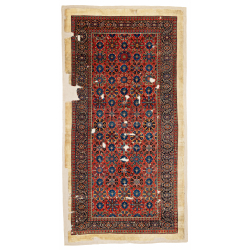
Early Bidjar381 x 196 cm (12' 6" x 6' 5")
Persia, first half 19th century
Condition: used, good pile, several holes and missing sections, several small repairs, several small areas of moth damage, sewn onto fabric
Warp: wool, weft: wool, pile: wool
This highly unusual Bidjar stands out not only for its design but also for its outstanding colors. The field features an endless repeat of two different flower shapes, which is framed with great precision by the borders. Only at the very bottom did the weaver make a small mistake by placing the blue secondary motif sideways. In addition, she included a few variations of the same motif within the field.
The overall design is derived from the well-known Mina-Khani pattern, except that the connecting tendrils with the white, five-petaled daffodil blossoms have been omitted. We recognize this pattern from Varamin and Baluch carpets. The circular blossoms are rendered in a rich variety of colors, whereas the secondary motif brings calm to the field by being rendered uniformly in blue. Compared to the Mina Khani pattern, however, a decisive change has taken place here: the motif has acquired a sense of direction. At its center stands an upright flower, and it has been given "legs" that remind us of the "feet" of the so-called Eagle Kazaks. Similar forms can also be found in other carpets from Northwest Persia.
The deep blue border features yellow and blue blossoms surrounded by leaves, as we know them in many variations. Particularly charming are the tiny white, five-petaled florets that encircle the larger blossoms. The dark green vine connecting the large leaves bears a hint of a Kufic border.
The fact that the carpet has a knotted beige - or, if you will, light camel-hair-colored - border all around is reminiscent of Sarab and Hamadan runners. It was a commendable act that someone took the trouble to save this rug and sew it onto a backing - something that is virtually unheard of with 19th-century Persian rugs, unlike Turkish ones. A true collector's item.
Estimate: € 6000 - 90004 000 € -
Startpreis / Startingbid
15 000 €Lot: 49
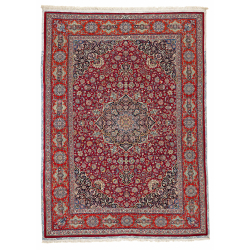
Fine Mashad with metal brocade signed...343 x 250 cm (11' 3" x 8' 2")
Persia, ca. 1930
Condition: very good, full pile, a small repaired tear in the lower right corner (approx. 6 cm)
Inscription on the kilim edging: "Ghanunhaye Falasafe (Laws of Philosophy)"
Warp: silk, weft: silk, pile: wool, silk and metal brocade
It is naturally difficult to capture such a large and complex carpet, full of the finest details, in a single image. You have to zoom in to appreciate the intricacy of the weaving and the motifs. In doing so, you also notice the immense number of colors.
When we focus on the medallion, the first thing that catches the eye is the silver metal brocading, which we also find in the corner spandrels. There, to the right and left of the larger brocaded area, are two palmettes that impressively demonstrate the effort that went into weaving this exceptional carpet. More than half a dozen colors come together in this single motif alone.
On top of the metal-brocaded central medallion lies a smaller yellow medallion, and below it, a dark blue one. Upon closer inspection, however, one can see that a further medallion is skillfully inscribed within the white-and-yellow lance-shaped leaves accented with red and blue. The cartouche-and-rosette border is a work of art in its own right, and the yellow fork-shaped leaves connecting them are of ravishing elegance. The basic principle is also maintained in the side borders, though there it is supplemented by an additional palmette.
The fact that such a carpet must have come from a master workshop is confirmed at the very top center of the side border by the signature of Khalil Khodyavi. He was at times a foreman in the legendary Amoghli workshop, but also established his own production alongside it.
It is extremely unusual that the carpet features flat-woven strips, known as "elems," not only at the top and bottom but also along the sides. Furthermore, repeating blue script cartouches are woven into these strips.
A flawless masterwork of great elegance, with flawless weaving and extraordinary color.
Estimate: € 25000 - 3500015 000 € -
Startpreis / Startingbid
6 000 €Lot: 50
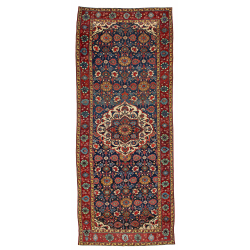
Northwestern Persian Carpet492 x 200 cm (16' 2" x 6' 7")
Persia, early 19th century
Condition: good, low pile in places, upper and lower borders restored, several small repairs, selvedges rebound
Warp: wool, weft: wool, pile: wool
A very impressive gallery carpet featuring a Harshang design and medallion. Against a dark blue background, the Harshang design unfolds in an elegantly serene movement, barely interrupted by any fill motifs. The term "Harshang" - Persian for "crab" - was used by Cecil Edwards in his seminal work "The Persian Carpet" on p. 49. It refers to the characteristic fork-leaf motifs, which are often depicted in white. In Caucasian carpets as well, these forms were often interpreted as animal motifs, yet they are clearly botanical representations. On our carpet, the fork-leaf motifs appear in blue and emerge from red palmettes. The rhythm of the field composition is particularly evident in the dominant yellow rosettes. At the bottom, a single rosette appears first, followed by two above it. The next single rosette is already partially hidden beneath the medallion and its pendants. It is particularly evident here that the medallion was, as it were, superimposed onto the continuous field composition. The subsequent pair of rosettes, as well as the next single rosette, are completely obscured by the medallion before the original rhythm logically resumes above it. In carpets of this type, the medallion is often positioned slightly below the exact center of the field. This should by no means be interpreted as a flaw. In these carefully designed workshop carpets, such a slight shift was likely employed deliberately to visually enliven the composition. A medallion with an almost identical design can be found in Jim Burns, "The Caucasus: Traditions in Weaving," no. 9. The carpet published there is described as a Karabagh and features a different color palette. It has a similarly elongated format; however, its field features a Herati design related to the Harshang design instead of the Harshang design. The borders of our carpet, on the other hand, are clearly in the Caucasian tradition. The main border is rendered in warm colors and features alternating stars, rosettes, and palmettes, surrounded by fork-shaped leaves - motifs from the classical Persian design canon.
Estimate: € 8000 - 120006 000 € -
Startpreis / Startingbid
6 000 €Lot: 51
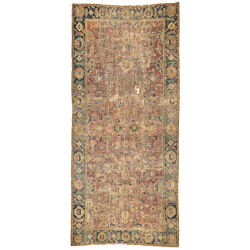
Early Isfahan543 x 244 cm (17' 10" x 8')
Persia, 17th century
Condition: used, low pile, several old repairs and reweavings, some holes, sides and ends slightly incomplete
Warp: cotton, weft: cotton, pile: wool
Palace carpets of this type were formerly often referred to as "Indo-Isfahan." On the one hand, some experts had doubts about their exact origin; on the other hand, many of these pieces reached Europe via Portuguese maritime trade. In the 17th century, they appear quite frequently in paintings from the Dutch Golden Age. Under Shah Abbas I (1587-1629), the court workshops of Isfahan - then the Persian capital - produced magnificent carpets of the highest quality. These carpets were not only used to adorn the palaces of the Safavid dynasty but were also highly sought after in the West. The typically red field is covered by an expansive pattern of spiral tendrils. Large palmettes, accompanied by sickle-shaped leaves, alternate with magnificent cloud bands, creating the movement that is both powerful and elegant - a hallmark of these carpets. Many of these pieces were preserved for centuries in European castles and palaces. With the economic decline of numerous European noble families toward the end of the 19th and the beginning of the 20th centuries, significant examples entered the art market and were acquired primarily by wealthy American collectors. Just how magnificent such carpets can still look in an interior today was demonstrated by the famous English interior designer Robert Kime, who worked, among others, for the then Prince of Wales, the future King Charles III. For his rooms - which he conceived as "refuges" - he had a particular fondness for using old carpets, even those in somewhat rustic condition. For Kime, a single carpet could define an entire room. His interiors thrived precisely on the warmth, patina, and sense of comfort that only objects passed down through generations can convey.
Hardly any other group of carpets embodies this combination of great art, history, and lived-in interiors more impressively than the Safavid palace carpets.
Estimate: € 10000 - 150006 000 € -
Startpreis / Startingbid
12 000 €Lot: 52
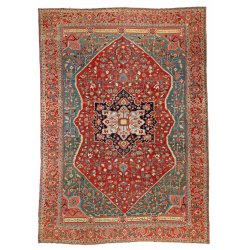
Serapi with Inscriptions416 x 300 cm (13' 8" x 9' 10")
Persia, late 19th century
Condition: very good, low pile in places but not worn, lower end slightly incomplete, minor small repairs
Inscriptions: Verses from a philosophical poem by Hafez
Warp: cotton, weft: cotton, pile: wool
Serapi carpets are among the most sought-after Persian hand-knotted carpets, yet it is now rare to find one of this quality.
The colors, patterns, and condition are first-rate, and the inscriptions at the top and bottom add the perfect finishing touch.
These inscriptions are an excerpt from a poem by the famous Persian poet Hafez, specifically Ghazal No. 45. The verses are preserved in the "Divan-e Hafez." Hafez lived in Shiraz from approximately 1315 to 1390.
It is therefore reasonable to say that the poem dates from the 14th century, likely from Hafez's poetic period between the mid- and late 14th century. Unfortunately, the exact year of its composition is not recorded.
Compared to earlier works, carpets from northwestern Persia of this period are expected to feature an increasingly abstract design language. In the case of our carpet, this has been achieved in a wonderful way: The design is by no means awkward, but rather distinctly well-thought-out and elegant. This is particularly beautiful to observe against the finely abraded green ground.
In the dark blue, eight-pointed medallion, the weavers have chosen a somewhat more floral style, only to return to a more linear, geometric design in the light blue star medallion above it. This interplay between floral and geometric forms lends the composition a special charm.
Anyone hoping to read about Serapi in Cecil Edwards' seminal work "The Persian Carpet" will initially be disappointed. Edwards writes that the term "Serape" (Sar?b) was occasionally used in America to refer to Georavan, a village near Heriz, but that it had already fallen out of use by his time. He does, however, include the town of Sar?b itself on his map of the Heriz district. Today, in the international carpet trade, the term "Serapi" is used primarily for particularly high-quality older carpets from the wider Heriz region.
In our piece, nearly every motif has been meticulously outlined. Particularly noteworthy is the detailed design of the inscribed bands at the top and bottom, whose borders are further enlivened by interposed flowers.
The classic border of palmettes and rosettes is rendered much more densely, thereby creating a striking contrast to the more spacious and lightly designed field. It is precisely this balanced relationship between bold geometry, delicate interior detailing, and an unusually harmonious color scheme that defines the exceptional quality of this carpet.
Estimate: € 20000 - 3000012 000 € -
Startpreis / Startingbid
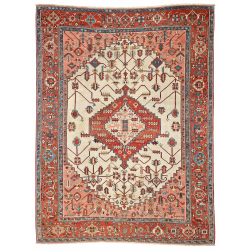
8 000 €Lot: 53
Serapi415 x 318 cm (13' 7" x 10' 5")
Persia, ca. 1880
Condition: good, low pile but not worn, both ends slightly restored, scattered professional repairs
Warp: cotton, weft: cotton, pile: wool
A wonderful and bright top-quality decorative carpet. Among carpets from the Heriz region, the name "Serapi" is primarily synonymous with magnificent design and a soft, harmonious color palette. Whether these carpets actually originate from the small town of Sarab remains unclear. Please also see our notes on Cecil Edwards regarding the other Serapi in this auction.
The open field so characteristic of these carpets is particularly pronounced in our specimen. It is fascinating to observe how the density of the motifs decreases quite organically from the corners toward the center, gradually giving way to the light-colored ground. The designer deserves praise for this - the composition is magnificent.
The angular interpretation of well-known motifs is a hallmark of carpets from this region. In the corners, these forms are placed almost like individual quotations; the lines that originally connected them have been largely omitted. This, too, has a surprisingly modern effect.
In the field, more of these connecting lines have been retained, though some have been stretched excessively long and reduced to just a few strokes. This creates an almost abstract effect that is a far cry from the traditional image of a lavishly blooming Persian rug.
The border, on the other hand, is kept in a classic style and, like the medallion, is rendered in a slightly darker shade of red. It thus forms, as it were, a frame that holds together the modern, open composition of the interior. The medallion, too, reveals the designer's distinct creative vision in the various interpretations of one and the same motif.
A magnificent piece that impressively demonstrates just how modern the abstract design language of a 19th-century Serapi can appear.
Estimate: € 14000 - 200008 000 € -
Startpreis / Startingbid
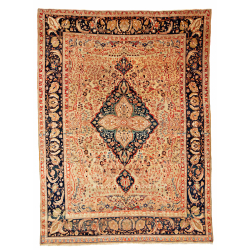
10 000 €Lot: 54
Kashan Mohtashem344 x 253 cm (11' 3" x 8' 4")
Persia, early 20th century
Condition: good, low pile in places in the lower border, upper ends slightly incomplete, selvedges partly restored and partly damaged
Warp: cotton, weft: cotton, pile: wool
In his seminal work "The Persian Carpet", on page 333, Cecil Edwards described the city of Kashan as one of Persia's less attractive cities, unkempt and dilapidated. In the 16th and 17th centuries, the city was three times as large as it was in the 19th century and famous for its silk, wool, and cotton products. At the end of the 19th century, the renaissance of Oriental carpets gave local weavers the opportunity to "build on" their earlier successes. Today, these elegant carpets are among the city's most sought-after antiques.
Page 341 features a carpet that, like ours, displays a pointed oval cross in the center. With its serrated borders, this carpet creates a strong sense of movement against the dark blue field and forms a striking contrast to the sharply defined diamond. Two small pendants complete the classical composition. It rests on a subdued-colored field adorned with a multitude of flowers, tendrils, and palmettes.
At the top and bottom edges of the field, next to the small blue medallions, a meadow landscape is depicted on gentle hills. Above it stand two large male peacocks, their beaks buried in a flower. Their magnificent tail feathers fan out widely across the field. The peacocks seem to be vying for the flower's attention.
The dark blue border is drawn with wonderful flair. Through its color coordination with the medallion, it creates a charming contrast to the subtly colored inner field.
A classic piece full of elegance and intrigue.
Estimate: € 20000 - 3000010 000 € -
Startpreis / Startingbid
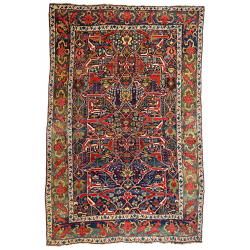
15 000 €Lot: 55
Bidjar Garrus505 x 342 cm (16' 7" x 11' 3")
Persia, second half 19th century
Condition: good, pile low in places, several small repairs on the sides, a few small repairs in the field
Warps: wool, weft: wool, pile: wool
With its massive size of over five meters and its exceptionally rich design, this carpet is one of the most impressive large-format hand-knotted pieces from the Bidjar and Garrus regions. The so-called Garrus design has a long history. Its predecessors can be traced back to the great Persian workshop carpets of the 17th century. In the 18th century, similar design concepts were adopted and further developed in northwestern Persia. Over the course of the 19th century, they became so closely associated with the Garrus region, south of Bidjar, that the term " Garrus" became established in carpet literature to refer to this group of patterns. This is by no means a single, unchanging design, but rather an entire family of designs that were continually reinterpreted by the weavers. Our carpet is a particularly beautiful example of this. Against a deep blue ground, an unusually large-scale, strictly organized composition unfolds. Majestic, white-outlined tendrils and palmettes divide the field into overlapping sections. In between are stylized trees and shrubs, blossoms, palmettes, and numerous small floral motifs. Despite the extraordinary richness of the design, the pattern never loses its clarity. No less remarkable is the wide main border. Against alternating green and blue backgrounds, large red palmettes unfold, framed by vigorous, yellowish-beige tendrils. The forms are still clearly reminiscent of the large floral and arabesque patterns of classical Persian carpet art, but here they are translated into the bold, geometrically abstract design language of Northwest Persia. Narrow, white-ground flowering tendrils frame this monumental border and simultaneously create a striking contrast to the deep-blue field. Our carpet impressively demonstrates why this group ranks among the most significant achievements of 19th-century Northwest Persian carpet weaving: monumental scale, vibrant colors, and a design that does not deny its roots in classical Persian carpet art, yet translates them into a completely independent stylistic language.
Estimate: € 25000 - 3500015 000 €