
Cart
0
Product
Products
(empty)
No products
Free shipping!
Shipping
0 €
Total
Product successfully added to your shopping cart
Quantity
Total
There are 0 items in your cart. There is 1 item in your cart.
Total products
(tax incl.)
Total shipping (tax incl.)
Free shipping!
Total
(tax incl.)
48
Early Bidjar
New
381 x 196 cm (12' 6" x 6' 5")
Persia, first half 19th century
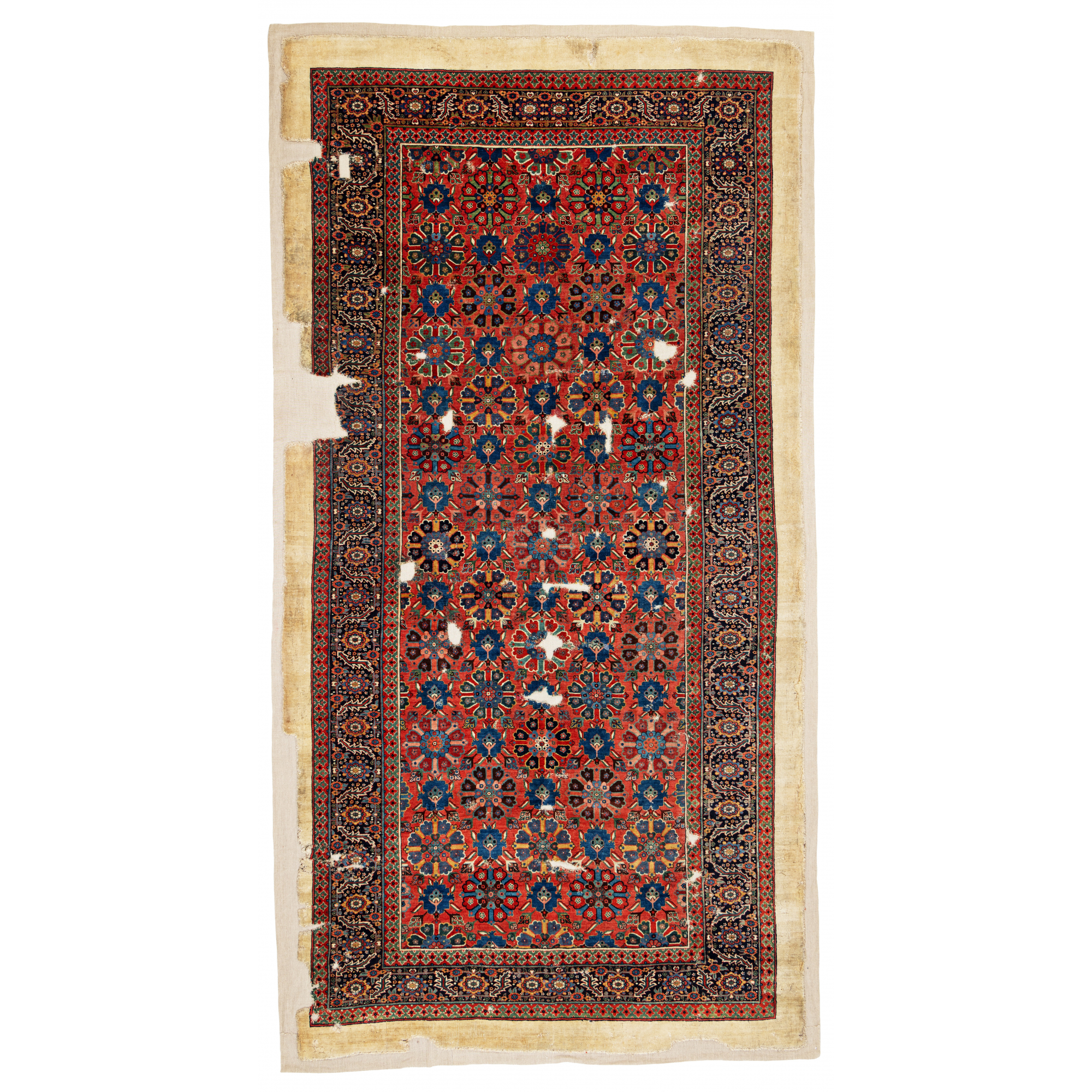
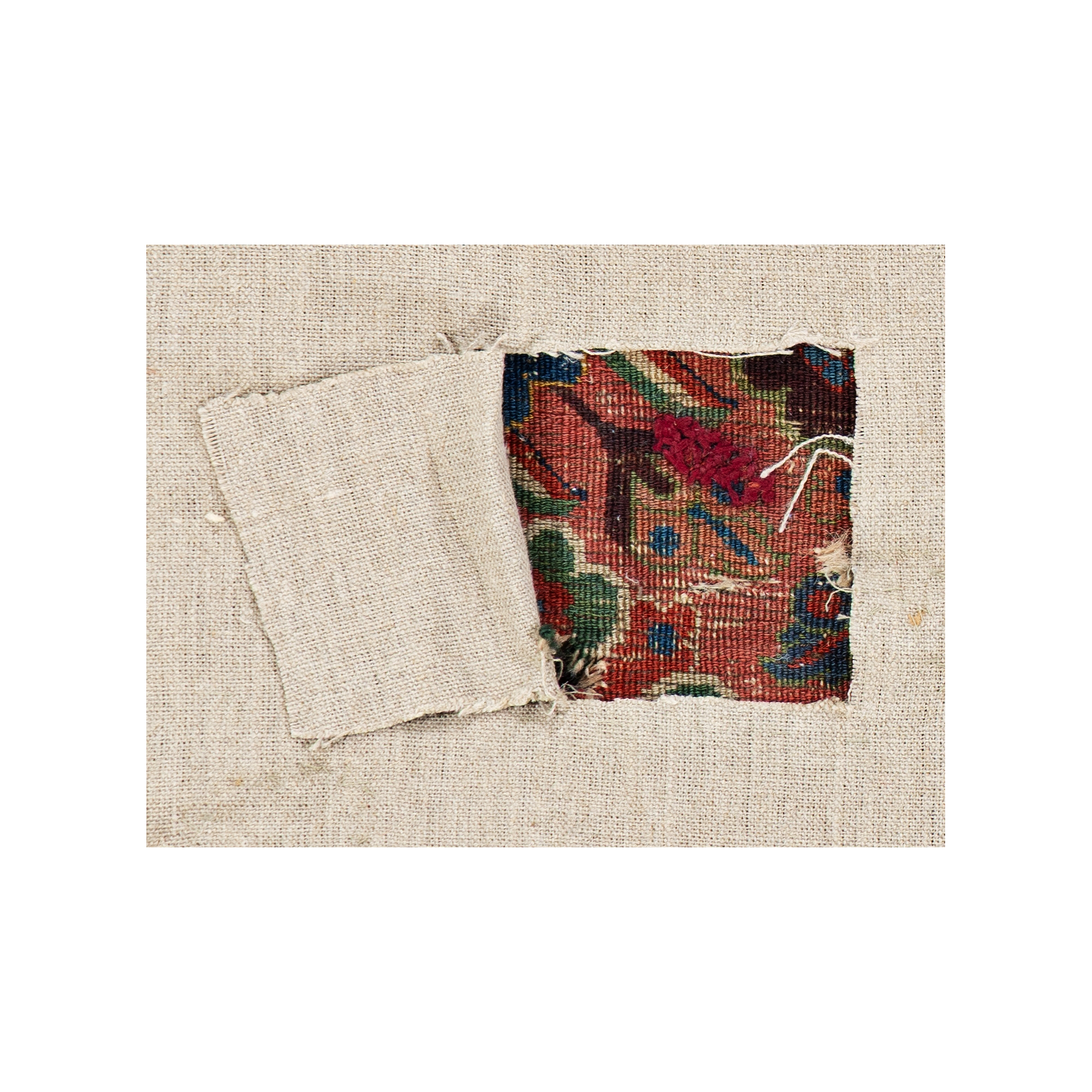
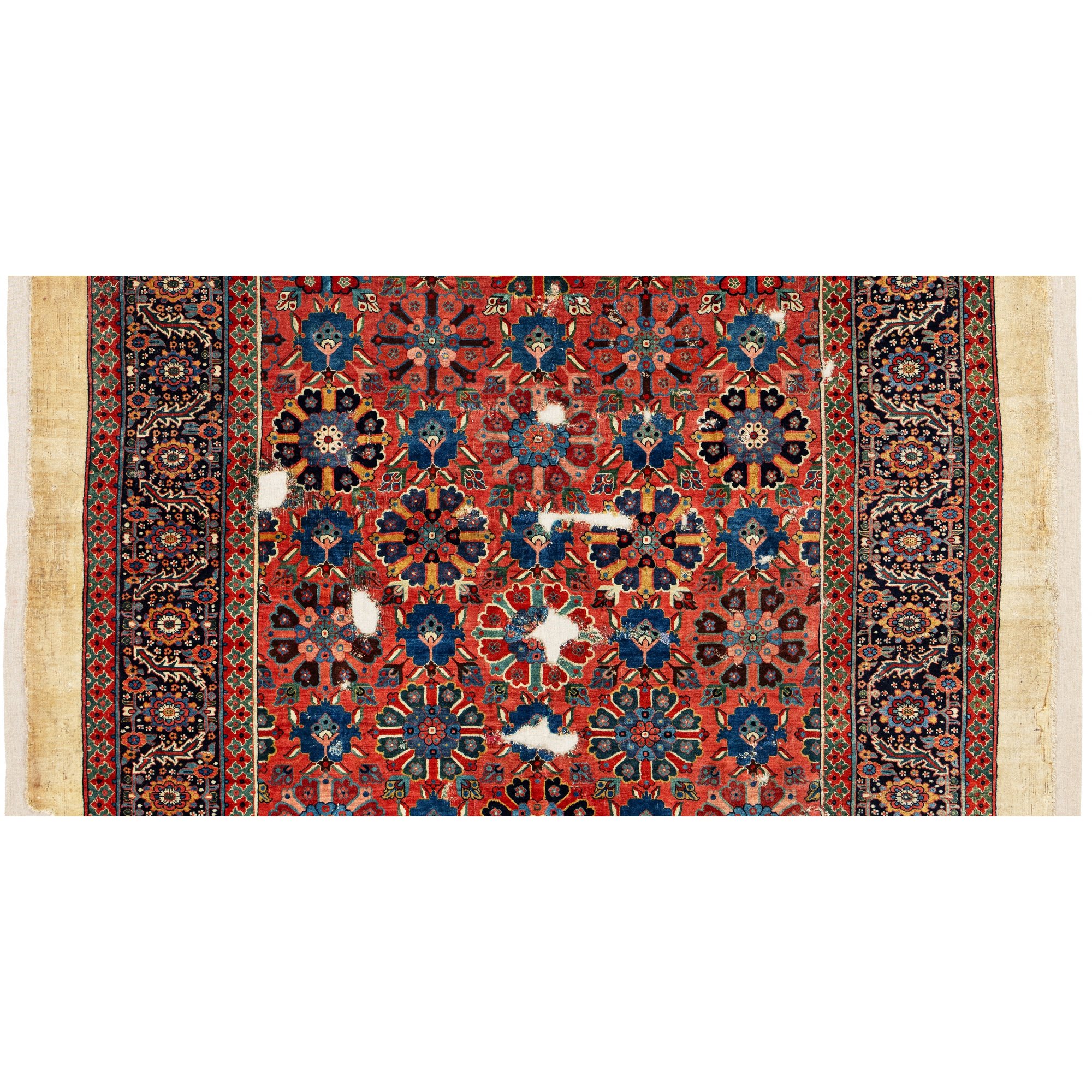
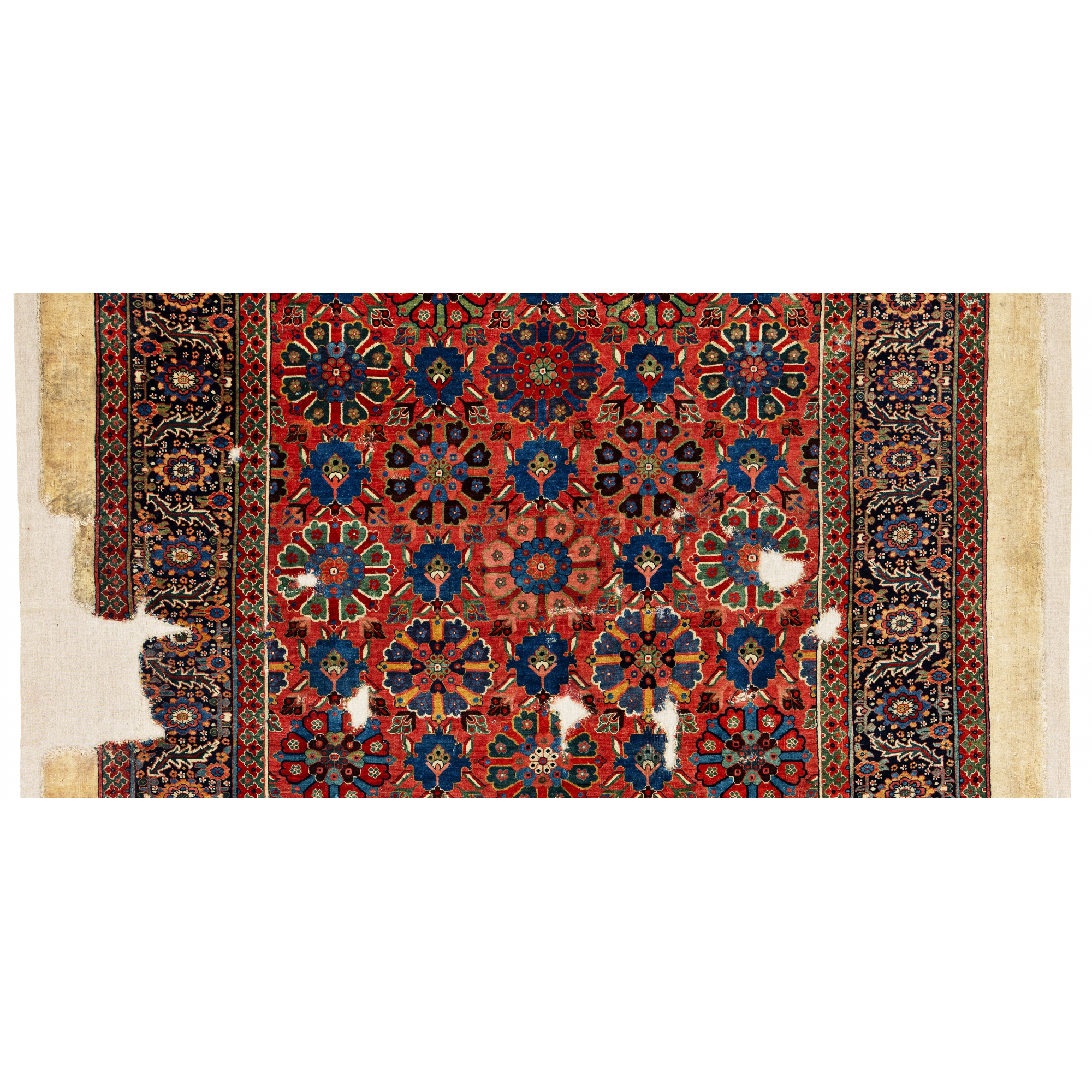
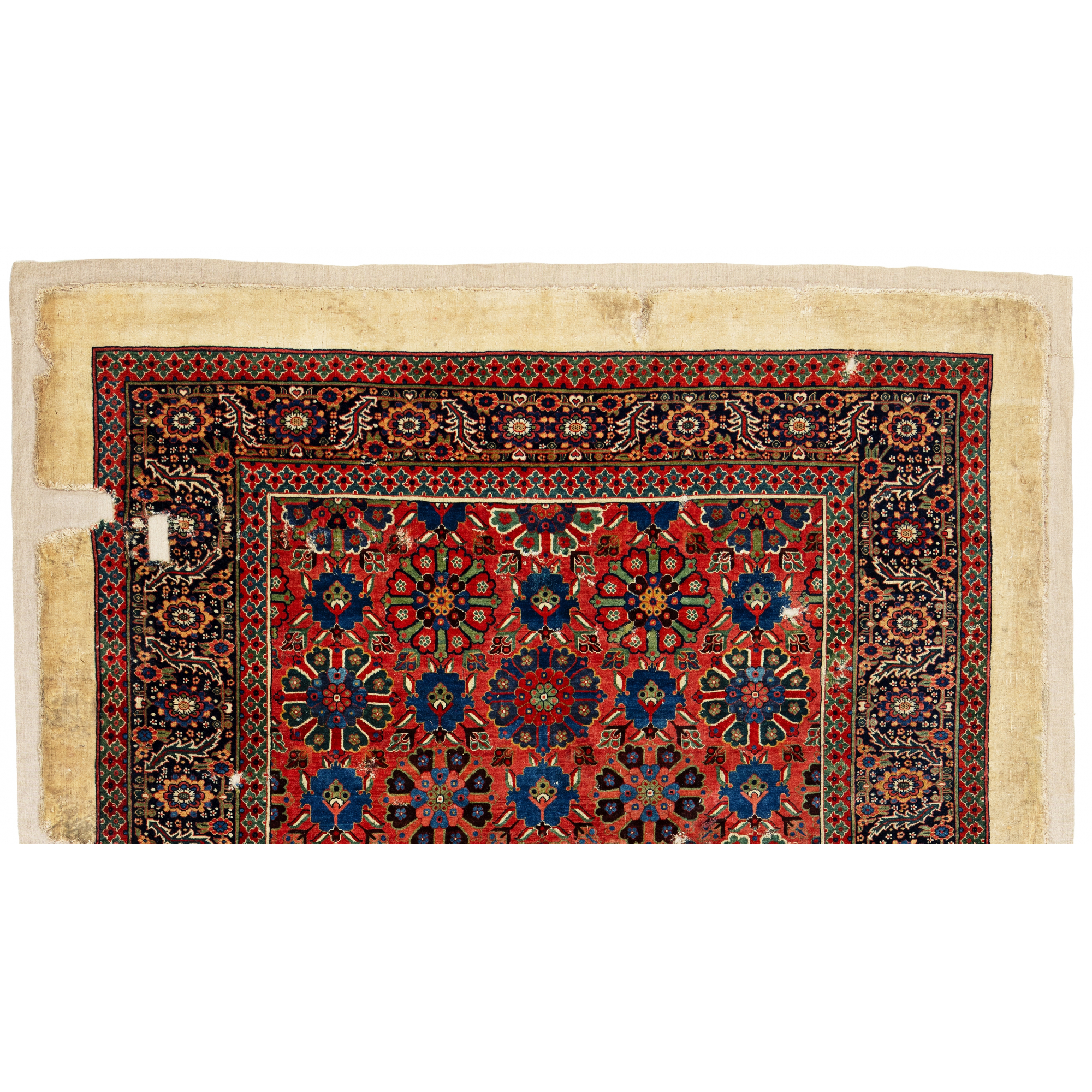
Condition: used, good pile, several holes and missing sections, several small repairs, several small areas of moth damage, sewn onto fabric
Warp: wool, weft: wool, pile: wool
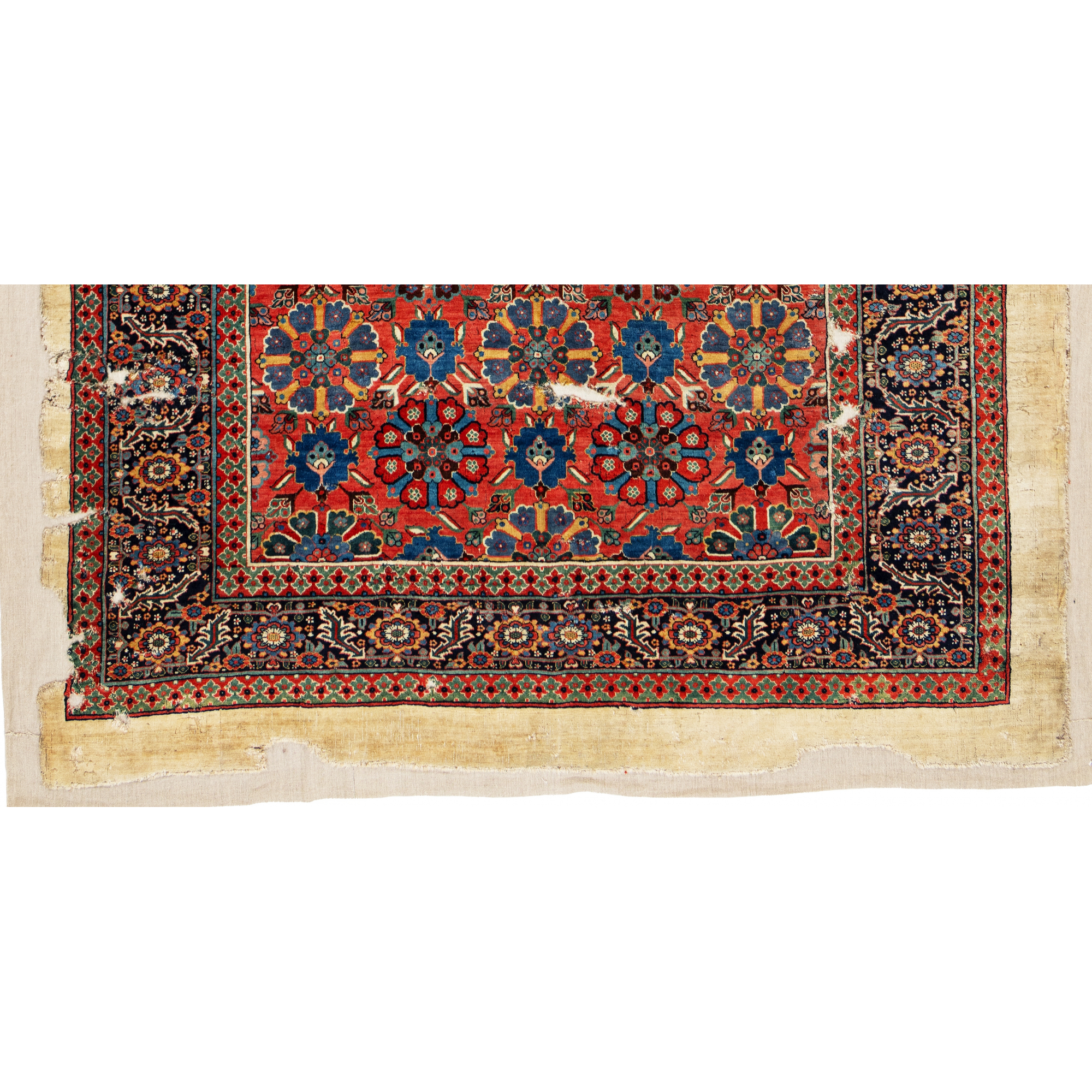
This highly unusual Bidjar stands out not only for its design but also for its outstanding colors. The field features an endless repeat of two different flower shapes, which is framed with great precision by the borders. Only at the very bottom did the weaver make a small mistake by placing the blue secondary motif sideways. In addition, she included a few variations of the same motif within the field.
The overall design is derived from the well-known Mina-Khani pattern, except that the connecting tendrils with the white, five-petaled daffodil blossoms have been omitted. We recognize this pattern from Varamin and Baluch carpets. The circular blossoms are rendered in a rich variety of colors, whereas the secondary motif brings calm to the field by being rendered uniformly in blue. Compared to the Mina Khani pattern, however, a decisive change has taken place here: the motif has acquired a sense of direction. At its center stands an upright flower, and it has been given "legs" that remind us of the "feet" of the so-called Eagle Kazaks. Similar forms can also be found in other carpets from Northwest Persia.
The deep blue border features yellow and blue blossoms surrounded by leaves, as we know them in many variations. Particularly charming are the tiny white, five-petaled florets that encircle the larger blossoms. The dark green vine connecting the large leaves bears a hint of a Kufic border.
The fact that the carpet has a knotted beige - or, if you will, light camel-hair-colored - border all around is reminiscent of Sarab and Hamadan runners. It was a commendable act that someone took the trouble to save this rug and sew it onto a backing - something that is virtually unheard of with 19th-century Persian rugs, unlike Turkish ones. A true collector's item.
Estimate: € 6000 - 9000
Persia, first half 19th century
Condition: used, good pile, several holes and missing sections, several small repairs, several small areas of moth damage, sewn onto fabric
Warp: wool, weft: wool, pile: wool
This highly unusual Bidjar stands out not only for its design but also for its outstanding colors. The field features an endless repeat of two different flower shapes, which is framed with great precision by the borders. Only at the very bottom did the weaver make a small mistake by placing the blue secondary motif sideways. In addition, she included a few variations of the same motif within the field.
The overall design is derived from the well-known Mina-Khani pattern, except that the connecting tendrils with the white, five-petaled daffodil blossoms have been omitted. We recognize this pattern from Varamin and Baluch carpets. The circular blossoms are rendered in a rich variety of colors, whereas the secondary motif brings calm to the field by being rendered uniformly in blue. Compared to the Mina Khani pattern, however, a decisive change has taken place here: the motif has acquired a sense of direction. At its center stands an upright flower, and it has been given "legs" that remind us of the "feet" of the so-called Eagle Kazaks. Similar forms can also be found in other carpets from Northwest Persia.
The deep blue border features yellow and blue blossoms surrounded by leaves, as we know them in many variations. Particularly charming are the tiny white, five-petaled florets that encircle the larger blossoms. The dark green vine connecting the large leaves bears a hint of a Kufic border.
The fact that the carpet has a knotted beige - or, if you will, light camel-hair-colored - border all around is reminiscent of Sarab and Hamadan runners. It was a commendable act that someone took the trouble to save this rug and sew it onto a backing - something that is virtually unheard of with 19th-century Persian rugs, unlike Turkish ones. A true collector's item.
Estimate: € 6000 - 9000