
Cart
0
Product
Products
(empty)
No products
Free shipping!
Shipping
0 €
Total
Product successfully added to your shopping cart
Quantity
Total
There are 0 items in your cart. There is 1 item in your cart.
Total products
(tax incl.)
Total shipping (tax incl.)
Free shipping!
Total
(tax incl.)
35
Early Karachoph Kazak
New
196 x 160 cm (6' 5" x 5' 3")
Caucasus, mid 19th century or before
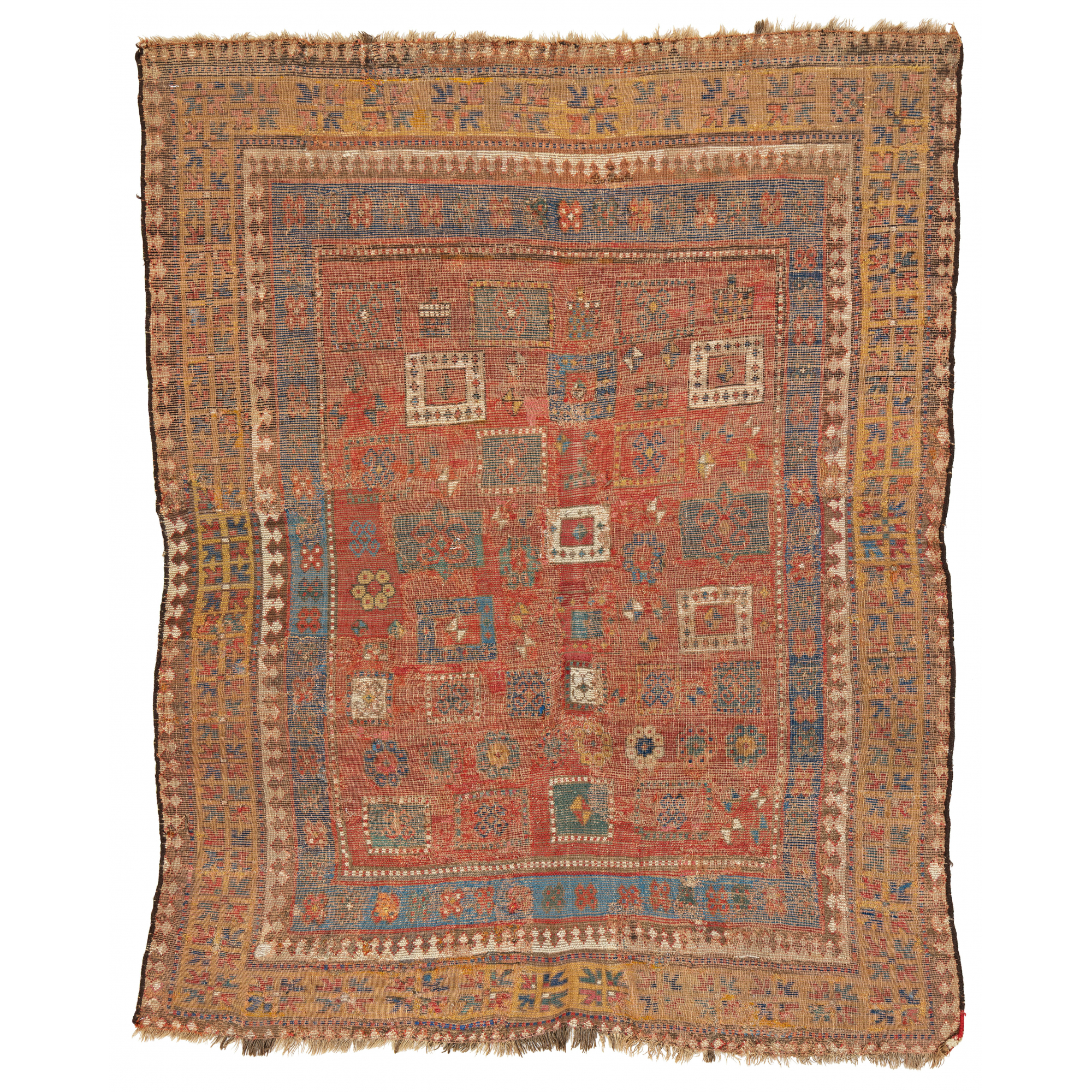
Condition: used, mostly good pile, corroded dark brown, sides and ends incomplete, several old repairs
Warp: wool, weft: wool, pile: wool
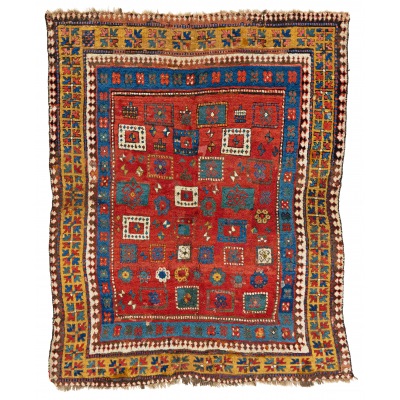
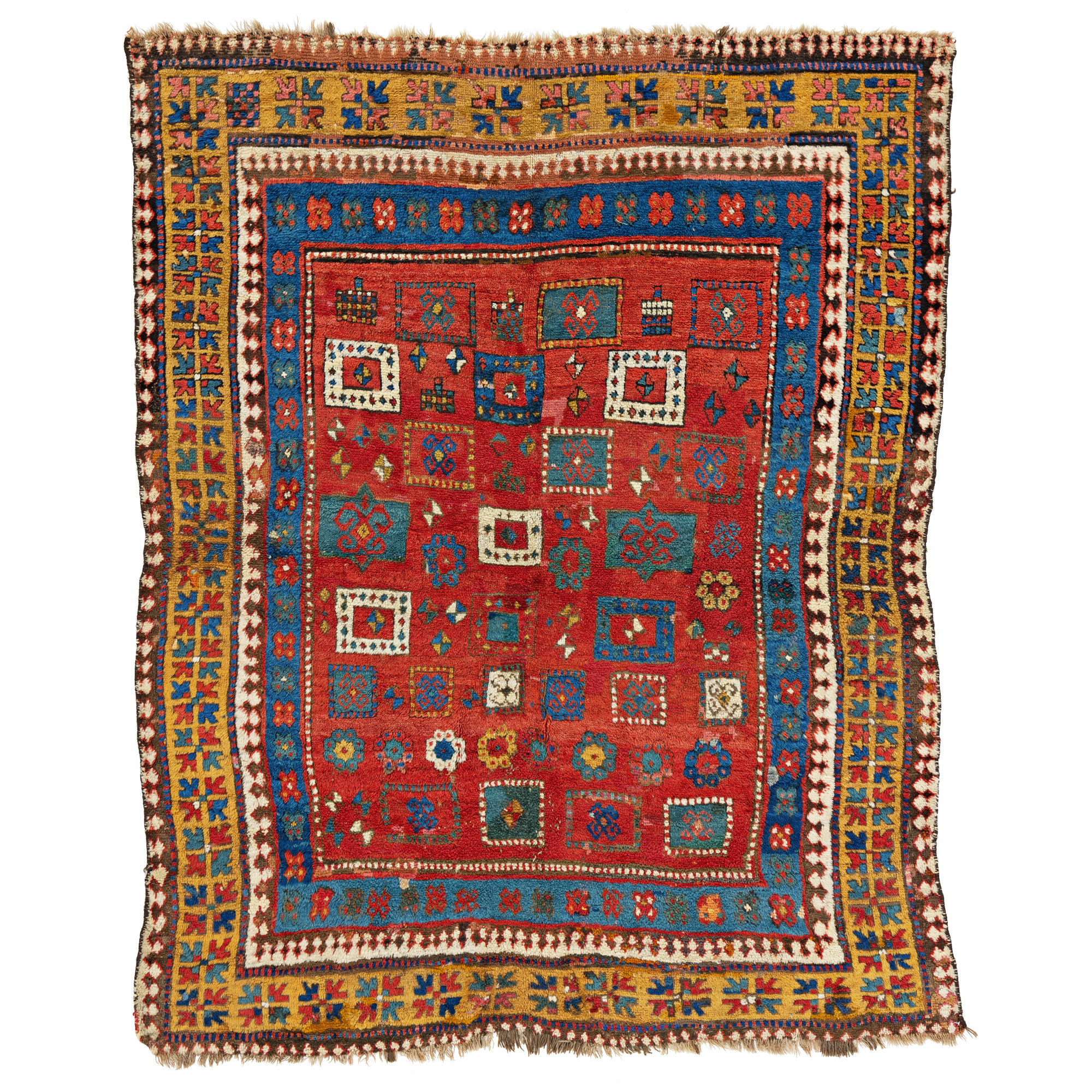
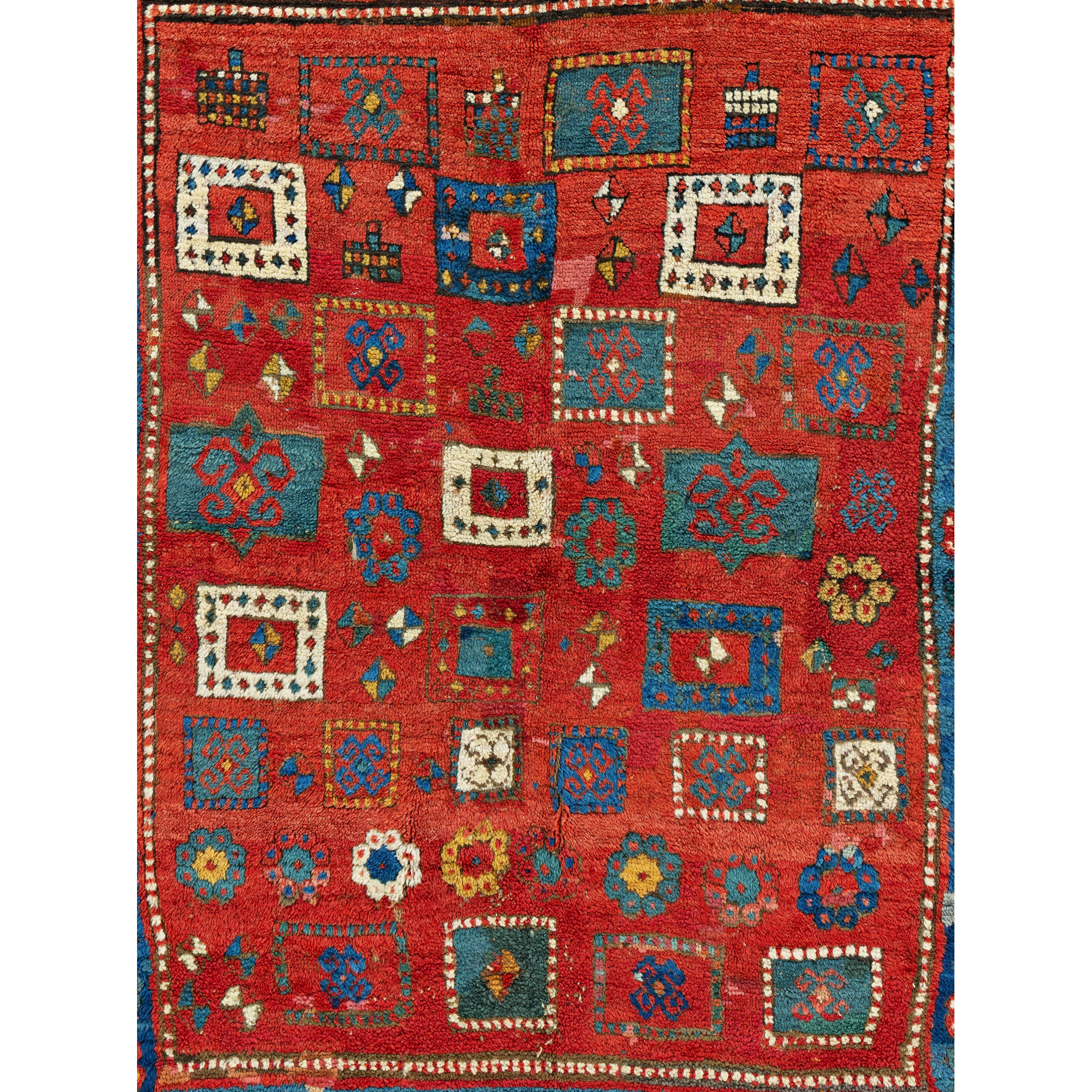
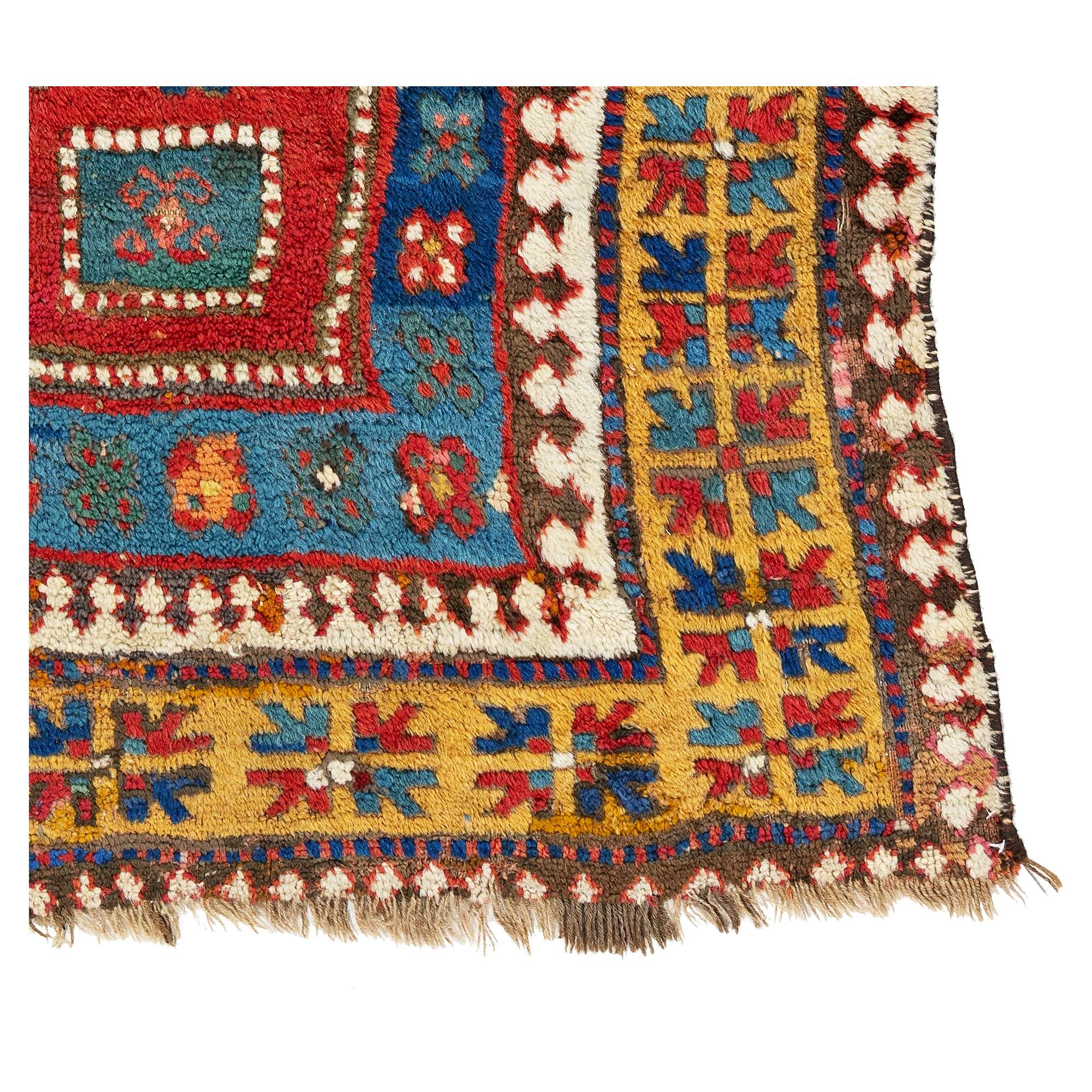
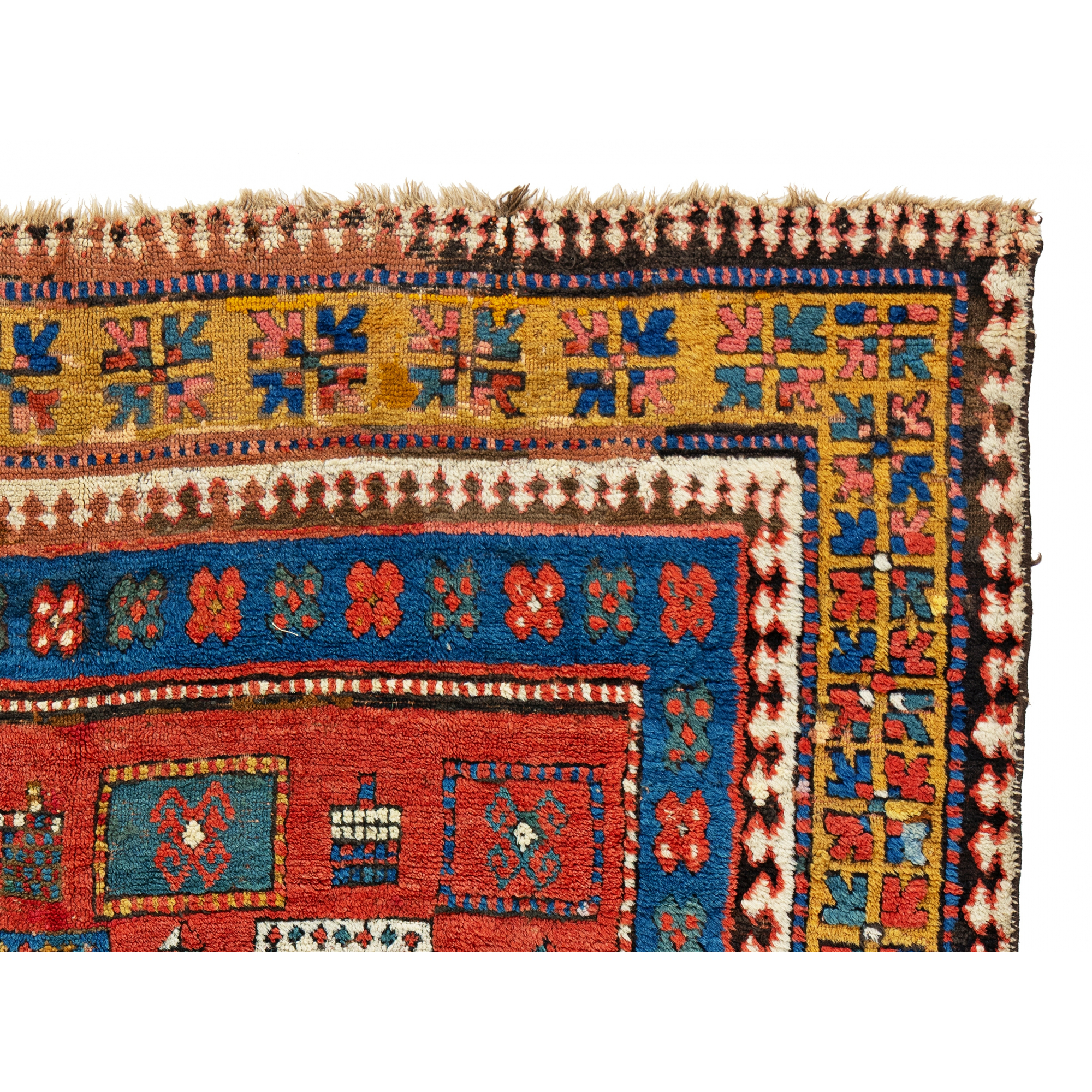
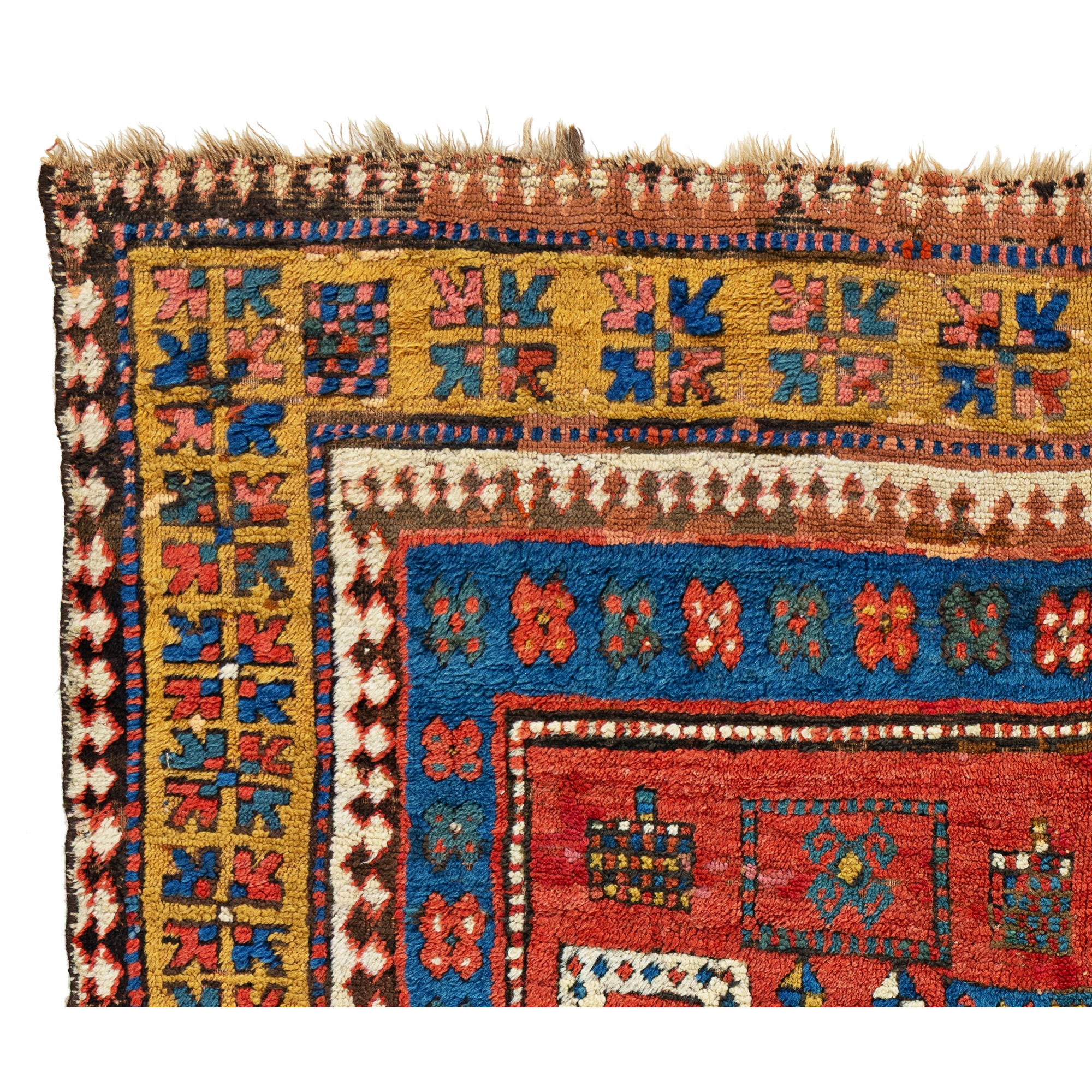
Some rugs just make you smile. You find yourself imagining the weaver saying to herself, "Enough with these ever-present, dominant octagons!" She then breaks down the classic Karachoph design into its individual parts and presents them as motifs of equal importance and similar size.
She begins at the bottom with a faithful reproduction of squares filled with double hooks, as seen on most Karachophs.
This is followed by a row of rosettes, which are typically used as filler motifs. The white and blue squares could be interpreted as representing the typical octagon, since their dotted border corresponds to the dotted field on which the octagon rests in classic Karachophs; see Eder, "Kaukasische Teppiche", nos. 28-33.
The two green medallions, pointed at the top and bottom, are, in contrast, a reference to the Fachralo region.
The checkerboard-like motifs shown in the upper section and at the top left then lead us back to the Karachophs.
There are certainly classic pieces with significantly more than four squares, but the central medallion is never omitted. For example, at Rippon Boswell on May 25, 2019, Lot 119, there was a beautiful Kazak that also features numerous squares, but it, too, has a medallion in the center, albeit a smaller one.
The majority of Karachophs with a medallion feature a vine leaf and calyx border, usually on a yellow ground and less commonly on a red ground. Our border, with four blossoms resembling arrowheads, by contrast, is quite rare.
A truly unique rug of village weaving artistry.
Estimate: € 7000 - 10000
Caucasus, mid 19th century or before
Condition: used, mostly good pile, corroded dark brown, sides and ends incomplete, several old repairs
Warp: wool, weft: wool, pile: wool
Some rugs just make you smile. You find yourself imagining the weaver saying to herself, "Enough with these ever-present, dominant octagons!" She then breaks down the classic Karachoph design into its individual parts and presents them as motifs of equal importance and similar size.
She begins at the bottom with a faithful reproduction of squares filled with double hooks, as seen on most Karachophs.
This is followed by a row of rosettes, which are typically used as filler motifs. The white and blue squares could be interpreted as representing the typical octagon, since their dotted border corresponds to the dotted field on which the octagon rests in classic Karachophs; see Eder, "Kaukasische Teppiche", nos. 28-33.
The two green medallions, pointed at the top and bottom, are, in contrast, a reference to the Fachralo region.
The checkerboard-like motifs shown in the upper section and at the top left then lead us back to the Karachophs.
There are certainly classic pieces with significantly more than four squares, but the central medallion is never omitted. For example, at Rippon Boswell on May 25, 2019, Lot 119, there was a beautiful Kazak that also features numerous squares, but it, too, has a medallion in the center, albeit a smaller one.
The majority of Karachophs with a medallion feature a vine leaf and calyx border, usually on a yellow ground and less commonly on a red ground. Our border, with four blossoms resembling arrowheads, by contrast, is quite rare.
A truly unique rug of village weaving artistry.
Estimate: € 7000 - 10000