
No products
Product successfully added to your shopping cart
There are 0 items in your cart. There is 1 item in your cart.
FINE ANTIQUE ORIENTAL RUGS 45 & TRIBAL ART 8 There are 215 Lots.
-
Startpreis / Startingbid
2 400 €Lot: 201
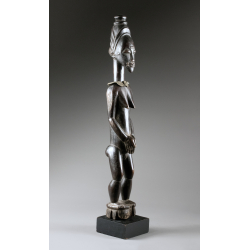
Female Figure of the BauleIvory Coast, 52 cm (1' 8")
The Baule, alongside the Senufo, are among the largest ethnic groups in Ivory Coast and are particularly renowned for their outstanding woodcarving traditions. The present exceptionally slender and elegant female figure is an impressive example of this distinguished artistic heritage.
The graceful and expressive figure is characterised by its harmonious proportions and an elaborately fashioned, towering braided coiffure, culminating in a distinctive double knot. The hands are folded one above the other in a serene, almost meditative gesture in front of the lower abdomen, resting closely against the body.
The finely modelled face displays three decorative scarification marks on the forehead. Further scarification patterns appear beside the corners of the mouth and beneath the temples, emphasising the meticulous treatment of the facial features.
A particularly attractive feature is the addition of four elaborately decorated brass discs, characteristic of Baule craftsmanship, threaded onto a chain and lending the figure an additional element of ornamental refinement.
The integrally carved base shows age-related traces of insect damage, which scarcely detract from the overall appearance. A magnificent patina, developed over many years, covers the entire figure, lending it a warm and vibrant presence.
The harmonious combination of elegant posture, finely executed details, and beautifully balanced proportions makes this female figure a particularly appealing example of traditional Baule sculptural art.
Provenance: Galerie Majestetic, Jean Michel Hunguene, France; Ethnogalerie Museum Schmiding, Austria; Gerhard F. Vesely, Austria.
Estimate: € 3500 - 38002 400 € -
Startpreis / Startingbid
1 300 €Lot: 202
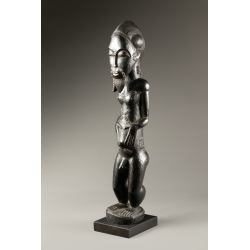
Male Figure of the BauleIvory Coast, 43.5 cm (1' 5")
The present statuette depicts a village elder, a wise and dignified man whose serene posture and expressive facial features convey authority and a lifetime of experience.
The bearded figure holds his hands folded in front of his abdomen, deliberately leaving the navel exposed. An elaborately fashioned coiffure and numerous carefully executed scarification marks on the face, neck, and both the front and back of the body emphasise the distinguished status and dignity of the individual represented within the village community.
The harmonious proportions and restrained yet powerful sculptural language lend the figure a remarkable presence. A rich and noble patina, developed through prolonged handling and use, covers the entire surface, imparting that distinctive character and timeless appeal so highly appreciated in early African sculpture.
The combination of dignified posture, meticulous attention to detail, and beautifully developed patina makes this statuette an impressive example of traditional Baule sculptural art.
Provenance: Oliver Castelani, France; Gerhard F. Vesely, Austria.
Estimate: € 1800 - 22001 300 € -
Startpreis / Startingbid
2 800 €Lot: 203
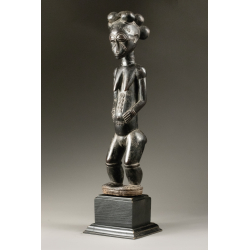
Female Figure of the AkyeIvory Coast, 39.5 cm (1' 4")
The present elaborately carved female figure is a fine example of the traditional sculptural art of the Akye, distinguished by its elegant form and the exceptionally meticulous execution of its decorative details.
Particularly remarkable is the characteristic coiffure, consisting of nine intricately arranged hair knots. The finely modelled, graceful face, with its slender nose and carefully executed scarification patterns, displays the distinctive stylistic features that set Akye sculpture apart from that of neighbouring ethnic groups.
The hands rest close to the body on either side of the navel. From this point, an elaborate scarification pattern extends upwards towards the breasts, consisting of three centrally arranged lines flanked on either side by a zigzag band.
The treatment of the reverse is equally deserving of attention. An intricate ornamental design of intersecting dotted lines covers the back, terminating in two similarly dotted circles in the upper section. This meticulous attention to detail, extending even to the reverse of the figure, testifies to the sculptor's exceptional artistic skill and sophisticated sense of design.
The integrally carved base shows age-related signs of wear on its underside. A beautiful patina, developed over many years, covers the figure, lending it additional depth and a distinctive presence.
The harmonious combination of elegant posture, characteristic coiffure, and elaborate scarification patterns makes this female figure a particularly appealing example of traditional Akye sculptural art.
Provenance: Geleni Bertrand, France; Gerhard F. Vesely, Austria.
Estimate: € 3500 - 38002 800 € -
Startpreis / Startingbid
1 500 €Lot: 204
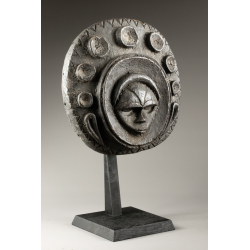
Mask of the EketNigeria, 25 cm (10")
The Eket, an ethnic group closely related to the Ibibio, inhabit southeastern Nigeria and possess a distinctive and significant artistic tradition. As early as the late 19th century, Christian missionaries entered the region and actively opposed traditional religious beliefs and ritual practices. Numerous sacred sites and ritual objects were destroyed in the process. It is therefore all the more remarkable that individual objects from this ancient cultural tradition have survived.
The present circular mask is an impressive testament to this increasingly rare artistic heritage. Its surface is covered with a pronounced encrusted patina, lending it a particularly archaic and evocative appearance.
At the centre of a double circular motif is a small mask-like face, carved with exceptional skill. Above it is a further, shallow circular element decorated with seven rounded, hollowed-out bosses. In the lower section, two loop-shaped ornaments terminating in pointed ends complete the unusual composition. The outer edge is framed by a continuous V-shaped pattern, effectively emphasising the strictly geometric character of the design.
The hollowed interior bears traces suggesting that the mask was used in ritual ceremonies.
The extraordinary combination of geometric ornamentation, finely carved facial features, and an impressive encrusted patina lends this rare object particular artistic and ethnographic significance.
Provenance: Miquel Porta, Spain; Gerhard F. Vesely, Austria.
Estimate: € 1900 - 24001 500 € -
Startpreis / Startingbid
900 €Lot: 205
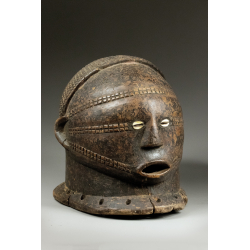
Helmet Mask of the Tabwa (Musangwe)Democratic Republic of the Congo (formerly Zaire), Height 28 cm (11")
Masks of this type originate primarily from the Marungu region in the southeastern Democratic Republic of the Congo and represent female ancestors. They are used particularly in fertility rituals, during which the spiritual powers of the ancestors are invoked to overcome infertility in women. Tabwa art reveals distinct influences from neighbouring ethnic groups, especially the Luba, with whom the Tabwa share close cultural and artistic ties.
The present brown-coloured helmet mask is distinguished by its almost spherical head and strictly geometric design. Particularly striking are the eyes formed from cowrie shells, which lend the face an unusual and penetrating expression.
The forehead, as well as the areas on either side of the eyes and mouth, is decorated with carefully carved square ornaments arranged in double rows. The coiffure follows the same characteristic geometric pattern, blending harmoniously into the overall composition.
The lower rim of the mask curves outwards and features numerous attachment holes, to which a fringe of raffia fibres was originally secured. The interior displays distinct traces of wear, suggesting prolonged ritual use.
The extraordinary combination of its spherical form, precisely structured geometric ornamentation, and expressive cowrie-shell eyes lends this helmet mask a remarkable presence, making it an impressive example of traditional Tabwa mask-making artistry.
Provenance: Patrick Jodry, France; Gerhard F. Vesely, Austria.
Estimate: € 1400 - 1700900 € -
Startpreis / Startingbid
2 000 €Lot: 206
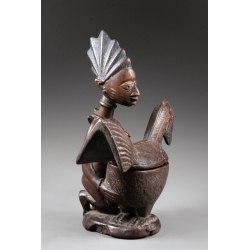
Female Bowl Bearer of the Yoruba, "Arugba...Nigeria, 35 cm (1' 2")
Female bowl bearers of this type were placed in shrines dedicated to Shango, the god of thunder, where they served as vessels for ritual offerings. The bowl carried by the figure was used particularly to hold kola nuts, which were presented as offerings to the deity. An elaborately carved representation of a rooster serves as the lid, lending the object additional symbolic significance and decorative appeal.
The present figure wears an intricately fashioned coiffure characteristic of the Abeokuta region. It is distinguished by its impressive size, harmonious proportions, and exceptionally accomplished sculptural execution, testifying to the remarkable skill and artistic mastery of an outstanding Yoruba carver.
Particularly appealing is the polychrome decoration in natural pigments, which lends the sculpture a vibrant appearance and effectively accentuates its carefully modelled forms.
The combination of ritual significance, masterful craftsmanship, and expressive colouring makes this female bowl bearer an exceptional and representative example of traditional Yoruba art.
Provenance: Jean-Pierre Laprugne, Galerie Mazarine, Paris, France; Gerhard F. Vesely, Austria.
Estimate: € 3600 - 40002 000 € -
Startpreis / Startingbid
2 000 €Lot: 207
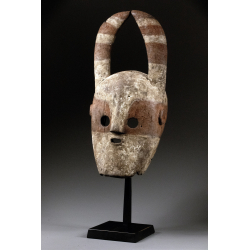
Horned Mask of the Galwa (Galoa)Gabon, 44 cm (1' 5")
The present rare and little-known bush spirit mask of the Galwa is a remarkable example of the traditional mask-making art of Gabon. Like the masks of the Kwele, it embodies the profound spiritual connection between humankind, nature, the forest, and its creatures. Within this traditional belief system, forest spirits occupy an important position, finding their visible expression in the art of mask-making.
The mask is crowned by two prominent horns, whose surfaces, like the face itself, are decorated with white kaolin and reddish laterite pigments. The expressive face is characterised by perfectly circular eyes, a small mouth, and finely modelled ears. The restrained yet compelling sculptural language lends the mask a distinctly archaic presence.
The interior displays a beautiful patina, developed through prolonged handling and use, testifying to its extensive ritual employment.
An almost identical comparable example is illustrated in the publication Les Forêts natales, p. 132, fig. 259.
The rarity of this mask type, its distinctive artistic design, and the impressive traces of ritual use make this object a particularly fascinating example of the traditional art of Gabon.
Provenance: Patrick Leclerc, France; Gerhard F. Vesely, Austria.
Estimate: € 3600 - 40002 000 € -
Startpreis / Startingbid
5 000 €Lot: 208
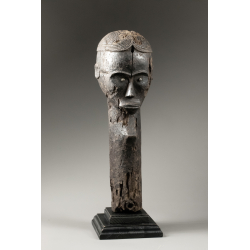
Reliquary Head of the Fang-Betsi, "Nlo Byeri"Gabon, Vallée de lOkano Region, 41 cm (1' 4")
Reliquary heads of this type rank among the most significant examples of traditional Fang art. They served to protect the relics of revered ancestors while simultaneously embodying their spiritual presence. As guardians of ancestral relics, they occupied a central position in the religious and social life of the community.
The present reliquary head is distinguished by its elongated, post-like neck with a prominently defined Adams apple, surmounted by a carefully carved and highly expressive head. The eyes are accentuated by inserted brass pins, lending the face an intense and penetrating expression. An elaborately fashioned coiffure, parted above the forehead, forms the uppermost feature.
Particularly remarkable is a narrow slit extending from the bridge of the nose to the hairline, terminating in an opening intended to receive magical substances. Feathers, small leafy twigs, and other materials impregnated with sacrificial or ritual substances could be attached here to enhance the spiritual potency of the object.
The surface displays age-related traces of insect damage, bearing witness to the long history of this extraordinary ritual object.
A comparable example is illustrated in the publication Les Forêts natales, p. 60, fig. 99.
The impressive combination of a strictly restrained sculptural language, meticulous carving, and ritually significant details makes this reliquary head a remarkable example of the traditional sculptural art of the Fang-Betsi.
Provenance: Miquel Porta, Spain; Gerhard F. Vesely, Austria.
Estimate: € 8000 - 100005 000 € -
Startpreis / Startingbid
6 500 €Lot: 209
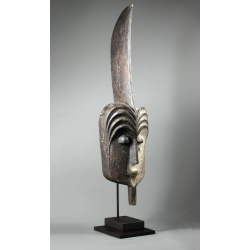
Face Mask of the Kota, "Emboli"Gabon, 95.5 cm (3' 2")
The present exceptionally large and rare Emboli mask of the Kota is distinguished by its monumental appearance and its distinctive, highly expressive sculptural language. Particularly characteristic is the imposing, sword-like central crest, which is interpreted as an exaggerated representation of the pronounced sagittal crest of a gorilla's skull.
Four prominently modelled eyebrows extend from the central crest and merge into the projecting nasal structure. Below them are a protruding mouth and a pronounced chin beard, which also served as a handle for the masked dancer. The downcast gaze lends the face an introspective, almost meditative expression, creating a striking contrast with the powerful, monumental design.
Particularly remarkable is the division of the mask's face into black and white sections, symbolically interpreted as representing the opposition between life and death.
Emboli embodies a forest spirit and plays an important role in the initiation rites of young people. The emergence of the Emboli masked dancer from the forest was an impressive and awe-inspiring event, intended to instil respect for the established social order while intimidating the uninitiated. The imposing appearance of the mask reinforced the authority and mysterious power of the spirit it represented.
The exceptional size, powerful sculptural execution, and symbolically charged colour scheme make this Emboli mask a particularly impressive and rare example of traditional Kota mask-making artistry.
Provenance: Michel Poulin, France; Private Collection of Gerhard F. Vesely, Austria
Estimate: € 12000 - 180006 500 € -
Startpreis / Startingbid
6 800 €Lot: 210
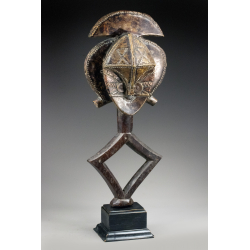
Reliquary Figure of the Shamaye-ShakeGabon, 42.5 cm (1' 5")
As among numerous other ethnic groups in Gabon, ancestor veneration occupies a central position in the religious and social life of the Shamaye-Shake. A profound belief in the spiritual presence of the ancestors, combined with the extraordinary imagination of the artists, gave rise to sculptures of unique expressive power and fascinating artistic form.
The creative diversity and artistic boldness of these works also exerted a lasting influence on prominent European artists. In particular, the pioneers of European modernism recognised new possibilities of formal expression in African sculpture and drew inspiration from its distinctive aesthetic qualities. The fascination these works inspired at the time remains undiminished among collectors and art enthusiasts to this day.
The present reliquary figure is an outstanding example of the rare Shamaye-Shake type and is distinguished by its exceptional artistic quality. The oval face is covered with brass sheeting, while delicate copper strips accentuate the eyes, lending the countenance an intense and penetrating expression. The prominently domed forehead is adorned with carefully punched ornaments, whose intricate detailing creates an appealing contrast with the clear, restrained sculptural forms.
The harmonious combination of sculptural modelling and skilfully executed metalwork lends the figure a particular dignity and an enigmatic presence.
A rare and important object of exceptional artistic merit, impressively illustrating the extraordinary creative achievements of Gabon's traditional reliquary art.
Provenance: Patrick Jodry, France; Private Collection of Gerhard F. Vesely, Austria.
Estimate: € 12000 - 160006 800 € -
Startpreis / Startingbid
4 000 €Lot: 211
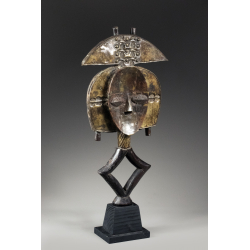
Reliquary Figure of the Kota-Obamba,...Gabon, 50 cm (1' 8")
Reliquary figures of the Kota-Obamba rank among the most significant examples of traditional Gabonese art. Serving as guardians within the ancestral cult, they were intended to protect the relics of revered ancestors while simultaneously embodying their spiritual presence.
The present figure belongs to a rare group distinguished by eyes fashioned from iron. These exceptional examples are known among specialists as "Blind Kotas". This unusual feature sets them apart from the far more commonly encountered reliquary figures with differently fashioned eyes.
Particularly remarkable is the elaborate treatment of the upper and lateral sections, which are covered with brass sheeting and richly embellished with finely executed ornaments and decoratively arranged brass nails. Two peg-shaped projections at the top and a further pair at the lower sides lend the figure additional sculptural definition and emphasise its characteristic silhouette.
The reverse displays distinct traces of age-related insect damage, bearing witness to the long history of this ritual object.
The unusual treatment of the iron eyes, the skilfully executed metal covering, and the meticulously worked ornamentation make this reliquary figure a rare and impressive example of traditional Kota-Obamba art.
Provenance: Patrick Jodry, France; Gerhard F. Vesely, Austria.
Estimate: € 6000 - 80004 000 € -
Startpreis / Startingbid
7 000 €Lot: 212
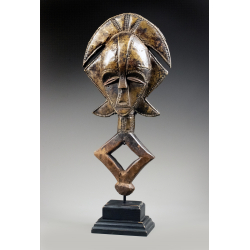
Reliquary Figure of the Southern Kota,...Gabon, 39 cm (1' 3")
Reliquary figures of the Kota rank among the most sought-after objects of traditional African art and have long held a particular fascination for international collectors. Originally created as protective figures within the ancestral cult, they are distinguished by their extraordinary sculptural language, their rigorous reduction to fundamental geometric forms, and the skilful combination of wood and metal. It was precisely this stylistic abstraction that fascinated leading European artists of the modernist movement and is frequently discussed in connection with the development of Cubism.
The present reliquary figure of the Southern Kota is a particularly fine example of this distinctive artistic tradition. The crescent-shaped upper section and the trapezoidal lateral elements are adorned with carefully punched ornaments. The forehead is defined by a wedge-shaped sheet of brass that extends downwards to form the prominent nose. A second wedge-shaped element, arranged in the opposite direction, forms the mouth.
The entire front of the figure is covered with brass sheeting. The diagonally positioned, slit-shaped copper eyes provide an appealing contrast, lending the strictly geometric face an intense and penetrating expression.
The underlying wooden structure displays a beautiful, richly developed patina of age, enhancing the distinctive character of this impressive ritual object. Comparable reliquary figures of this type are dated to the 19th century, as demonstrated by examples in the Pulitzer Arts Foundation.
An almost identical comparable example is illustrated in the publication Les Forêts natales, p. 99, fig. 223.
Further ethnographic background on ancestor veneration and the significance of reliquary figures can be found in the description of catalogue lot 210.
The harmonious combination of rigorously geometric forms, finely punched metalwork, and an impressive patina of age makes this reliquary figure an outstanding example of the traditional art of the Southern Kota.
Provenance: Miguel Porta, Spain; Gerhard F. Vesely, Austria.
Estimate: € 10000 - 150007 000 € -
Startpreis / Startingbid
1 000 €Lot: 213
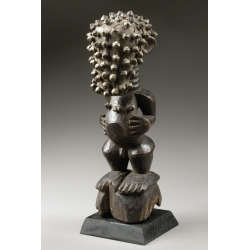
Power Figure "Nkisi"Democratic Republic of the Congo, 23 cm (9")
Power figures, known as "Nkisi", played an important role in the traditional religious and social life of various ethnic groups in the Congo region. They served primarily to protect against illness, ward off harmful influences, and promote healing. Once the carver had completed such a figure, it was entrusted to a ritual specialist known as a "Nganga". Only through the ceremonies performed by the Nganga and the insertion of spiritually potent substances did the figure acquire its supernatural power, enabling it to fulfil its protective and healing functions.
The present small male figure is distinguished by its compact and expressive sculptural form. The arms rest closely against the sides of the body, leaving the navel area exposed, where a small, suggested opening was intended to receive medicinal substances. The neck is adorned with several carefully carved rings, lending the figure additional sculptural definition.
Particularly remarkable is the unusual treatment of the head, face, and upper torso, which are densely covered with handmade brass nails. This striking surface decoration is associated with protection against and the treatment of smallpox, a disease once greatly feared. The numerous metal pins may symbolically refer to the characteristic skin lesions caused by the disease.
The combination of a rigorously simplified bodily form, ritual significance, and extraordinary metal embellishment lends this small power figure a compelling presence, making it a remarkable testament to the traditional healing and protective practices of the Congo region.
Provenance: Miguel Porta, Spain; Gerhard F. Vesely, Austria.
Estimate: € 1200 - 14001 000 € -
Startpreis / Startingbid
1 300 €Lot: 214
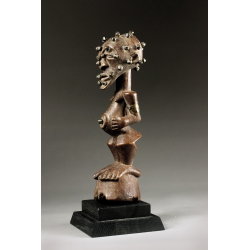
Power Figure "Nkisi"Democratic Republic of the Congo, 25 cm (10")
As already described in catalogue lot 213, power figures known as "Nkisi" served in the traditional religious life of various ethnic groups of the Congo region to protect against illness, evil forces, and harmful influences, as well as to ward off witchcraft. These figures acquired their spiritual potency only through the ritual practices of a traditional healer, known as a "Nganga", who activated them by inserting magical substances and performing the appropriate ceremonies.
The present figure is distinguished by its exceptionally fine and expressive sculptural execution. Particularly remarkable are the numerous handmade brass nails distributed across the head, face, and mouth area, which also surround the opening intended to receive ritual medicinal substances. This unusual surface treatment lends the figure a compelling presence and emphasises its original ritual significance.
Characteristic of this type of figure are the powerfully modelled legs, which are disproportionately large in relation to the upper body. They lend the statuette a remarkable sense of stability and monumentality that extends far beyond its actual dimensions.
The figure stands on an integrally carved base, the underside of which displays age-related traces of insect damage.
The harmonious combination of powerful sculptural forms, meticulously executed details, and extraordinary brass-nail decoration makes this Nkisi a particularly impressive example of the traditional ritual art of the Congo region.
Provenance: Miquel Porta, Spain; Gerhard F. Vesely, Austria.
Estimate: € 1600 - 18001 300 € -
Startpreis / Startingbid
1 500 €Lot: 215
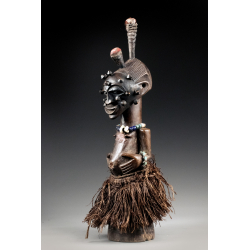
Power Figure "Nkisi"Democratic Republic of the Congo, 38.5 cm (1' 3")
The present exceptionally finely carved power figure, or "Nkisi", is an impressive example of the traditional ritual art of the Congo region. As already described in catalogue lots 18 and 19, such figures served to protect against illness, evil forces, and harmful influences, as well as to ward off witchcraft. They acquired their spiritual potency through the ritual practices of a traditional healer, known as a "Nganga", who activated them by introducing magical substances and performing the appropriate ceremonies.
The exceptionally meticulous sculptural execution of this figure is distinguished by a wealth of remarkable details. Two small horns are positioned on the head, their openings sealed with red cloth and presumably intended to contain ritual substances. Hand-forged brass nails further enhance the striking appearance of the head.
The arms rest closely against the sides of the body, leaving the navel area exposed, where a small, suggested opening was intended to receive medicinal substances. The figure wears an elaborately twisted copper bracelet around its left wrist. A necklace of blue and white tubular beads, complemented at the centre by two cowrie shells, provides an appealing decorative accent and a subtle contrast of colour.
Traces of ritual offerings remain visible on the chest, bearing witness to the figure's original ceremonial use. Particularly noteworthy is the well-preserved raffia apron covering the genital area, which provides valuable evidence of the object's original adornment.
The harmonious combination of finely modelled bodily forms, diverse decorative elements, and preserved ritual attributes lends this power figure an exceptional presence. It is a particularly fine and expressive testament to the traditional religious art of Central Africa.
Provenance: Miquel Porta, Spain; Gerhard F. Vesely, Austria.
Estimate: € 2000 - 25001 500 €